The industrial style in decoration comes from old warehouses, but it fits in homes if done in moderation. Materials, colours, and measurements to achieve it.
At Casa y Deco, we love the industrial style in decoration, although we confess that for a while we confused it with leaving the house half-finished. Exposed brick, visible pipes, black metal, and aged wood: ingredients that sound like a warehouse and, when well dosed, give any living room an unmistakable character. If you’re wondering how to achieve it without ending up living in a warehouse, this article is for you.
From Abandoned Warehouses to the Living Room
The style arises more from necessity than whim. At the end of the last century, artists and creators occupied old factories in SoHo, New York, because they were cheap, had high ceilings, and enormous windows. Over time, that rough and honest look became an aesthetic that was copied in lofts in Berlin, London, and Barcelona. What had been a practical solution ended up being a statement of intent: no hiding the installations and no perfect finishes.
The interesting thing is that this philosophy can be transferred to a hundred-square-metre flat without any problem. What’s needed is to understand which elements support it and in what proportion to use them. That’s where many go wrong, as happened to us during our first renovation when we filled the living room with iron, and the result looked like a mechanic's workshop with a very comfortable sofa.
Materials and Colours That Work
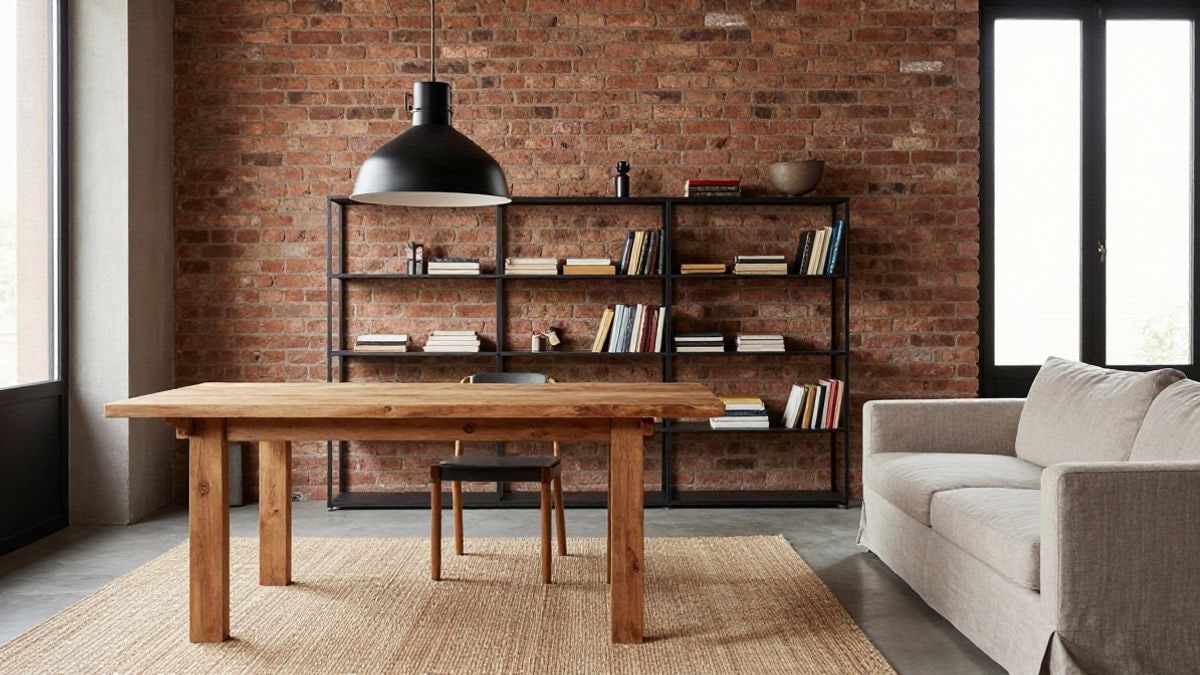
There are four materials that almost never fail: exposed brick, metal (especially black matte iron or oxidised finish), solid wood with marked grain, and cement or microcement for floors and walls. If you have to choose just one to start, let it be wood, as it softens the overall look and prevents the house from feeling cold.
In terms of colour, the key is a neutral base. Cement greys, off-whites, sandy beiges, and browns reminiscent of rust form a calm background against which dark details stand out. We usually follow a simple rule: about 60% neutrals in walls and textiles, 30% wood and warm materials, and 10% black, which is where the character appears. Matte black for lamps, frames, and table legs, and not much more.
For those wanting to do it at home, a metal tube shelf with wooden shelves about three centimetres thick is one of the most rewarding projects. It can be assembled in an afternoon, costs little, and completely changes the look of a wall. However, it’s advisable to secure it to the wall with appropriate anchors for the type of partition, as the weight of the books is more noticeable than it seems.
Lighting deserves its own chapter. An industrial-style pendant lamp over the dining table works best if its base is about 75 to 80 centimetres from the tabletop, and if the bulb is filament or warm light, around 2700 kelvin. With cold light, any space of this style looks like a nineties office, and that’s not what we’re aiming for.
Furniture, Textiles, and the Trick of Not Overdoing It
Furniture with a workshop soul are the stars: open metal shelves, dining tables with iron legs, plank benches, or aged leather armchairs. If your budget is tight, large chains like Ikea have lines with this look at reasonable prices, although it’s wise to tweak handles or change the lamp to prevent the whole from looking like it came out of a catalogue.
Textiles are what humanise the whole. A linen sofa in sandy tones, a rug about 160 by 230 centimetres in natural fibre, and wool cushions in muted colours break the hardness of the materials. We confess that a thick fabric blanket we placed over the sofa saved our living room: suddenly the space stopped looking like a warehouse and started to feel like a place you want to stay.
There’s a risk worth monitoring: accumulation. The industrial style requires a certain calculated lack, and when it’s filled with vintage objects, posters, giant clocks, and plants in iron pots, the feeling of a restaurant set quickly appears. Our recommendation is to choose a single star object per room, for example, an antique trunk or a large workshop lamp, and let the rest breathe.
Where to Apply It and Where Not
The living room and open kitchen are the spaces that best respond to this style, especially if they have high ceilings or exposed beams. In bedrooms, it’s wise to be more cautious, as cold metal and rough finishes can detract from rest. The most sensible approach is to limit it to a floor lamp, a wooden headboard, and bedding in soft tones. In the bathroom, a matte black tap and a wooden shelf can work very well, as long as the coverings and wood can withstand humidity.
If you have a brick wall that isn’t authentic, that’s fine. There are thin brick panels, just over one and a half centimetres thick, that can be applied with adhesive and give the same effect without heavy construction. Just make sure to order them with irregular joints, as perfection is exactly what this style tries to avoid.
In the end, the industrial style in decoration works when the house feels livable and not staged. Start with two or three materials, maintain a neutral palette, and leave a single focal point. And if the house still ends up looking like a warehouse, at least it will be a warehouse with a sofa you want to lie on.

You may also like