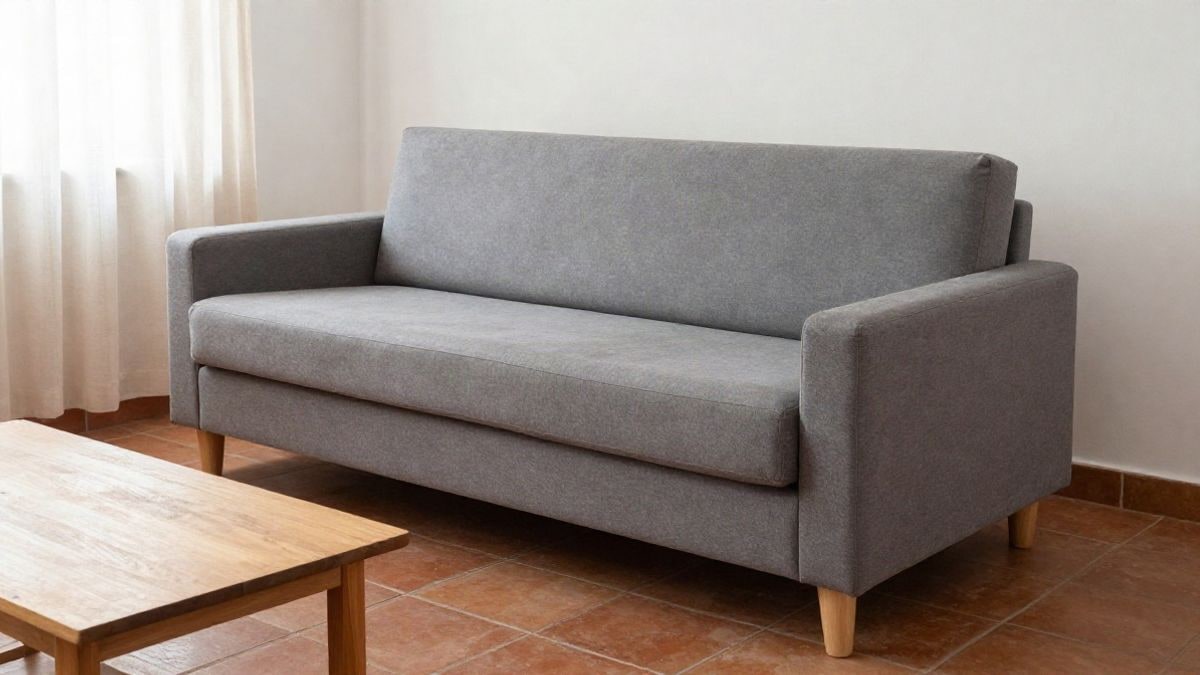
At Casa y Deco, we love to remind you that a good sofa bed can save a small living room, but it can also become the worst purchase mistake of the year if you don't choose wisely. How to choose a sofa bed is, in reality, a matter of measurements, mechanisms, and the use you will give it every day. I confess that it took me two weekends to learn this after buying one that opened as well in the catalogue as it did poorly in my hallway. That's why we tell you what really matters before you pull out your card.
Before Looking at Colours, Measure the Space
The first step is to measure twice. How to choose a sofa bed starts by calculating where the piece of furniture will live, and that includes the space it needs to open. A closed sofa may fit perfectly against the opposite wall and yet block the balcony door as soon as you unfold it. Leave at least 60 to 70 centimetres free in front of the sofa to be able to open it without balancing acts.
Next, check the depth. For a normal living room, the usual closed depth is between 80 and 95 centimetres. If it is deeper, it takes up too much space; if it is narrower, the open bed usually falls short in back support and surface area. And here comes the detail that almost no one checks: the width of the open bed. For one person, a reasonable width is about 140 centimetres, and for sleeping as a couple, at least 160 centimetres. The length of the mattress should be around 190 or 200 centimetres, especially if someone in the house is over one hundred and eighty.
Mechanisms: The One You Choose Defines Your Daily Life
The mechanism is the part that gives the most surprises. There are three families you will almost always find. The clic clac is the most classic: the backrest folds down onto the seat and the surface becomes flat. It is simple and usually lightweight, but the mattress it incorporates tends to be thin, about 10 to 14 centimetres, and the bed ends up being somewhat low and hard. It works well if the sofa bed is for occasional guests.
The Italian system opens with a single movement, pulling the seat forward. It is much more comfortable for daily use because the bed is higher, firmer, and more stable. However, it has a greater load, so it is advisable to test that it moves smoothly and without jerks. The third is the book opening or double body, which requires more lateral space but offers a very even sleeping surface. If you have a narrow hallway, discard it from the start.
A tip we often give during our visits to stores: try the mechanism yourself, without the help of the salesperson. If you need two people to open it, in three months you will leave it closed and use it as a regular sofa.
The Mattress Matters More Than It Seems
This is where people make the most mistakes. A sofa bed with a 10-centimetre mattress may be great for a nap, but it becomes uncomfortable for sleeping four nights in a row. Look for a mattress of 14 to 18 centimetres if you are going to use it regularly. And check that the mattress is made of a single piece or that the seams do not press on your back, something that is immediately noticeable when lying down.
The foam also matters. For daily use seating, a density of about 25 to 30 kilos per cubic metre holds up well without flattening in a few months. If the foam is softer, the sofa will seem comfortable in the store and will sink within a year. Always ask about the density because many technical sheets omit it, and it is the detail that really tells you how long it will last.
Materials and Upholstery: Think About Real Life
A sofa bed is used more than a normal sofa because it opens, closes, is dragged, and bears more weight. That's why the upholstery needs to be durable. Quality microfibres are a very practical option: they resist stains, can be cleaned with a damp cloth, and do not pill as much as other fabrics. Blends of linen and cotton look beautiful in bright living rooms, but they wrinkle and absorb more if there are children or pets.
Be careful with the colour. A light shade looks great in the catalogue image, but on a sofa that opens and closes daily, it accumulates marks from rubbing on the arms and the edge of the seat. If you have a dog, a medium grey or earthy colour is much more forgiving. And check that the legs are made of solid wood or well-finished metal, as they suffer the most when dragged.
Where to Buy It and What to Check Before Paying
There is a wide range of options, from large chains like Ikea, which has very reasonable compact models, to design stores with custom-made pieces. What matters is not so much the place as the warranty and delivery service. Ask how many years the warranty covers the mechanism, as it is the part that breaks down the most, and whether you can return it if it does not fit through the door or staircase when you get home.
Before closing the purchase, do one last practical check: take a tape measure, measure the door, the hallway, and the space where the sofa will go, and mentally run it through the entryway. It seems obvious, but it is one of the most common mistakes we see. A well-chosen sofa bed is one that opens easily, provides good rest, and adapts to how you really live. If it meets those three criteria, the decoration will come naturally.

You may also like