How to decorate a small hallway doesn’t require square metres, but rather good decisions. Shallow furniture, well-placed mirrors, and warm light do most of the work.
At Casa y Deco, we love the hallway, that space that is hardly seen but says a lot about a home. If yours has little space, don’t worry: knowing how to decorate a small hallway doesn’t require space, but rather good decisions. With shallow furniture, well-placed mirrors, and warm light, you can achieve a practical, bright, and personalised entrance.
Before Decorating, Measure and Think About How You Enter
The first thing we do at Casa y Deco, before buying anything, is measure. It seems obvious, but we confess that more than once we have seen someone take home a beautiful console that then didn’t fit without blocking the passage. Measure the width of the entrance, the distance between the door and the opposite wall, and above all, the free space you need to move. As a practical reference, it’s advisable to leave at least 90 centimetres of free passage for comfortable movement, and more if you enter with a pram or luggage.
Then, make an honest list of what gets left in the entrance every day: keys, bags, mail, coats, umbrellas, and shoes. With that list, decorating stops being a matter of taste and becomes a plan. A small hallway must function first and look good second, and in that hierarchy lies almost all the secret.
Shallow Furniture and, If Possible, Suspended
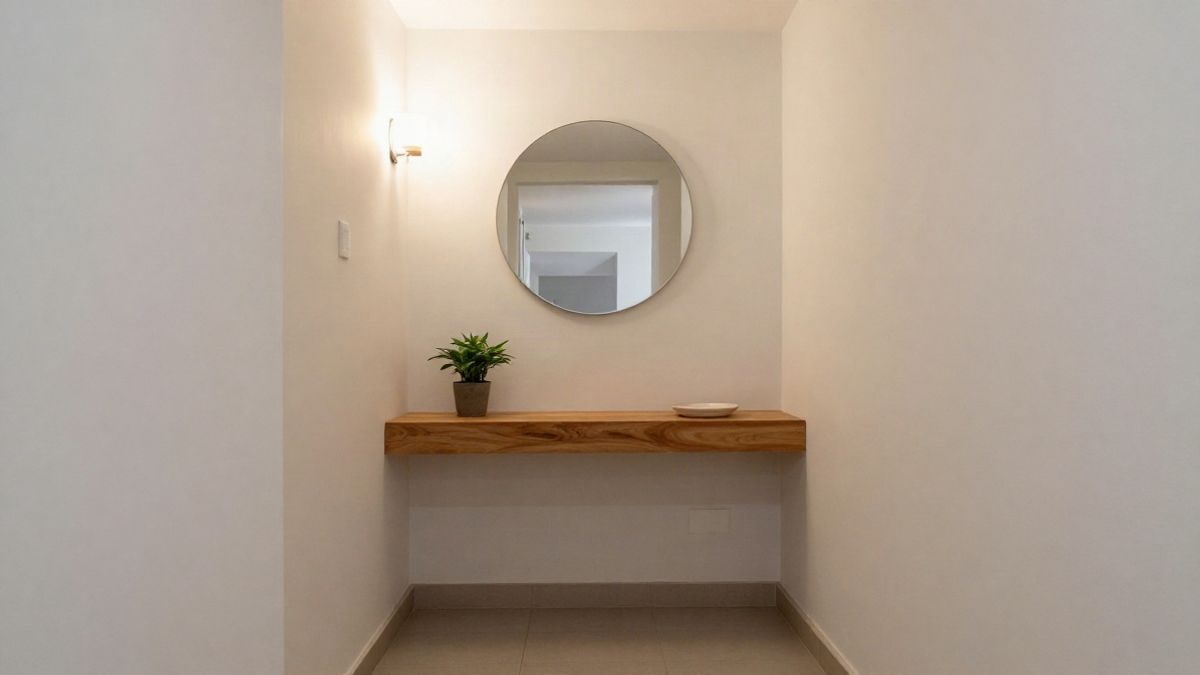
If there’s one change that is immediately noticeable, it’s replacing a large depth piece of furniture with a shallower one. A console 15 to 25 centimetres deep already serves as a surface for keys and mail without stealing half the hallway. Suspended models go even further: without legs, they leave the floor visible, making the space seem larger and cleaning underneath much easier.
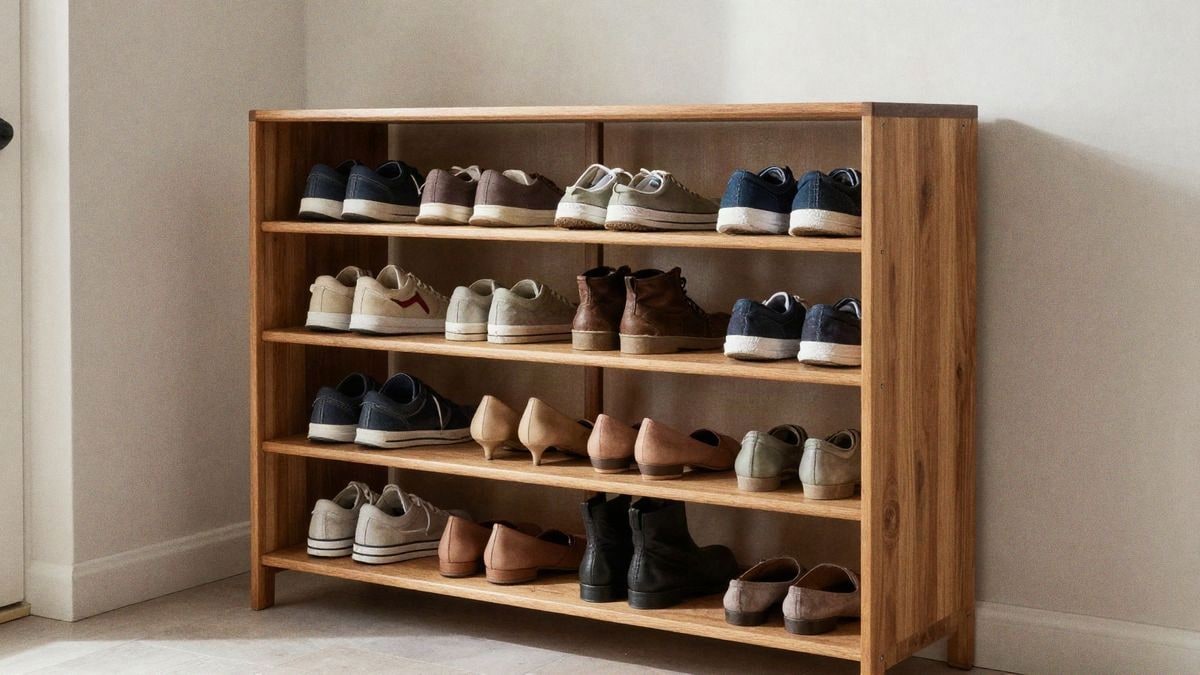
For footwear, narrow shoe cabinets with folding doors or flaps usually have depths of between 15 and 20 centimetres, allowing several pairs to be stored in a corner or behind a door. If space is really tight, a bench with internal storage solves two needs at once: sitting down to put on shoes and hiding what we don’t want to see.
The Mirror, Better as an Ally than as Decoration
Here we are very honest: the mirror is the element that most transforms a small hallway. Placed opposite a source of natural light or in front of the door of an adjoining room, it multiplies brightness and provides a depth that no painting can achieve. It saved me in the entrance of an old flat, where the light arrived so late it felt like a subway car at midnight.
Watch out for the size. A mirror 60 to 80 centimetres wide over the console usually provides a balanced proportion in small entrances, and on narrow walls, a vertical model works very well. Place it at a comfortable height to see yourself standing, with the centre around 150 centimetres from the floor, and avoid placing it directly opposite the door, as it will force you to dodge it every time you enter or exit.
Warm Light and Layering
A dark hallway is noticeable as soon as you cross the door. The most effective solution is usually to combine discreet general lighting with a point of support light, such as a wall sconce or a small lamp on the console. Regarding colour temperature, we stick with warm tones, around 2700 or 3000 kelvin, as they convey a cosy atmosphere that cold lights cannot achieve. If your furniture includes integrated LED lighting, take advantage of it: it provides indirect light and makes the entrance look cared for even at night.
And if natural light comes in, be careful what you place in front of the window. A tall piece of furniture can completely block it, so in that case, it’s better to opt for low or floating pieces that let the light through.
Light Colours, Few Objects, and a Well-Thought-Out Rug
Light colours remain our go-to recommendation for small entrances. Off-whites, beige, soft grey, or light wood reflect light and make the walls seem further away. That doesn’t mean everything has to be neutral: a slightly more intense tone on a single wall, or a detail in matte black on the handles, adds character without overwhelming.
The rule we repeat the most is to have fewer objects and choose them better. A vase, a tray for keys, and a small plant usually suffice. We confess that we struggle to resist hanging pictures everywhere, and some of our entrances have ended up with more frames than wall. Now we prefer one or two thin pictures, hung at the same height, instead of a gallery that takes up the entire wall.
If the floor allows it, a narrow rug can define the entrance area. Choose a size that leaves at least 10 centimetres of visible floor on each side and that doesn’t have raised edges, as these are the most likely to cause tripping in a passage space.
Long and Narrow Hallways: Tricks to Prevent Them from Looking Like a Tunnel
If the hallway is the start of a long corridor, the challenge is to avoid the tunnel effect. Painting the back wall a slightly darker tone visually brings it closer, while pictures placed on one side create focal points along the way. If you hang them, use thin frames to avoid reducing the passage width.
With rugs, it’s better to fragment than to elongate. Two or three short pieces separated from each other break the continuous line and make the hallway more dynamic than a single long rug, which usually accentuates the gallery feeling. And if you need a support point, look for consoles with thin metal legs and depths that do not exceed 25 centimetres.
Common Mistakes We Often See
Besides buying furniture that is too large, there are three mistakes we see in almost every entrance we encounter. The first is leaving the floor cluttered with boxes, umbrellas, and loose shoes, which makes the space seem even smaller. The second is hanging hooks that are too low or too protruding, which force clothes to brush against them when passing. The third is relying solely on ceiling light: a standalone sconce completely changes the feeling when arriving home.
If you have to start with something, begin with the piece of furniture that obstructs the most. Replacing a large depth console with one 20 centimetres deep is usually the improvement that is most noticeable in a small hallway, and it requires the least amount of renovation.

You may also like