Choosing curtains for the living room doesn't have to be a hassle: just measure correctly, think about the light coming in, and choose tones that complement your walls. Here’s what has worked for us.
At Casa y Deco, we love talking about curtains because, although they may seem like a minor detail, they completely change the feel of a living room. How to choose curtains for the living room is one of the questions we receive most often, and the short answer is to think about three things at once: the light coming in, the style you already have, and the use you will give them. We confess that in our first house, we bought curtains in such an intense green that they looked like a forest in the middle of the dining room. We changed them after a month, so here’s what we’ve learned along the way.
Measure Before Buying Anything
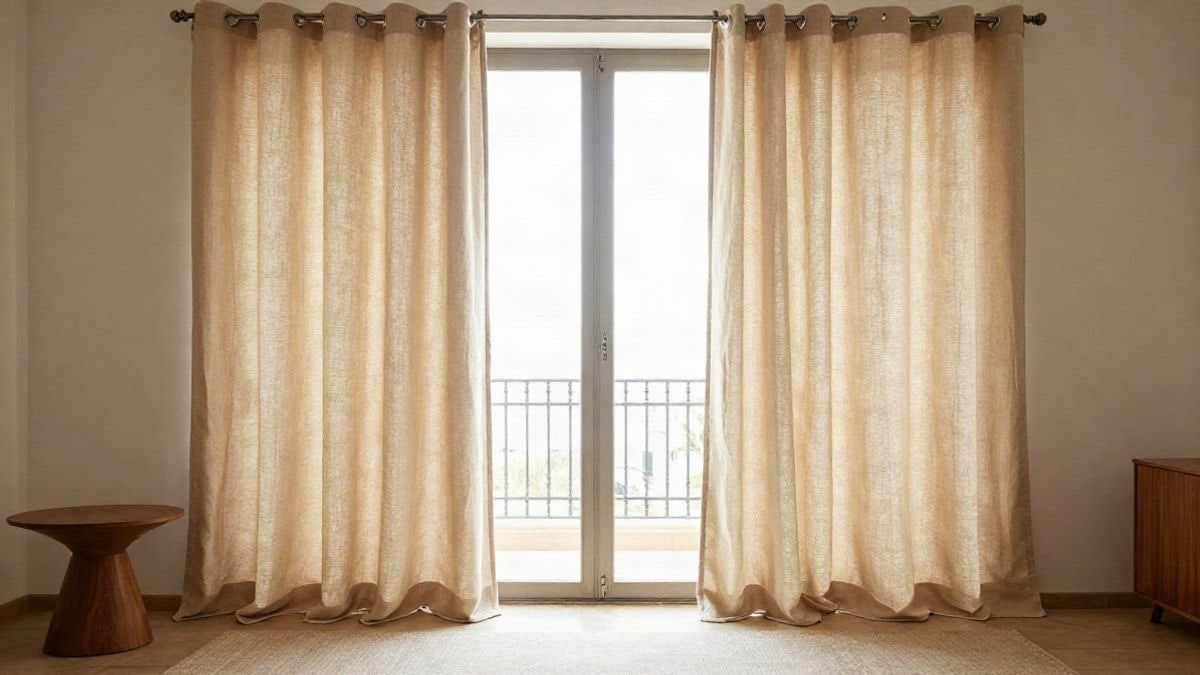
The first step is to grab a tape measure. Measure the width and height of the window and note both figures. The rod should be placed 10 to 15 centimetres above the frame, making the window appear taller. Curtains usually fall from there to the floor or stop a couple of centimetres above it, depending on your preference. As for the width, a practical rule is that the fabric should be two to two and a half times the width of the window, so the curtains look full when gathered and not stuck to the glass.
This is where we see the most mistakes. Many people only measure the opening and end up short. If your window measures 180 centimetres wide, look for a set of about 360 to 450 centimetres of total fabric. It seems like a lot of fabric, but the result is worth it.
Colours: What Each Shade Does
Colour changes the perception of space. Light shades, such as off-white, beige, or ivory, add spaciousness and freshness, and are the safest choice if your living room is small or has little light. Dark shades, like navy blue, burgundy, or bottle green, provide depth and a cosy feel. Neutral tones, such as stone grey or taupe, work best with almost any decor. Bright colours act as a focal point, as long as there is something else in the room to accompany them.
We have a rule: if the wall is a bold colour, it's better to choose curtains in a softer tone. If the wall is white, you can play around. One detail that almost no one considers is orientation. In north-facing living rooms, the light comes in cold, so it's advisable to choose warm tones like sand, ochre, or terracotta to compensate. In south-facing rooms, with plenty of sunlight, dark colours help to avoid glare.
Fabrics Depending on How Much Light You Want to Let In
Before looking at colours, decide what you want the curtains for. If you're looking for darkness to watch TV or take a nap, you need a heavy or opaque fabric. Velvet and thick linen work very well, and if you want total blackout, look for a blackout lining. If you want light, voile, gauze, or fine cotton allow brightness without turning your living room into a showcase.
I confess that I fell in love with velvet in a shop and bought it without considering the weight. I ended up putting a sheer curtain underneath to balance it out in a sun-drenched living room. If you have a very exposed window, the combination of sheer and thick curtain is the most practical in the world: the sheer filters during the day and the curtain closes at night.
How Each Living Room Style Fits
The style of your living room takes precedence over any trend. In modern decor, the best choice is plain fabrics with texture, in tones like grey, stone, or graphite. Avoid very heavy patterns, as they detract from the overall cleanliness.
The Nordic style calls for whites, light greys, and sand, with natural fabrics like linen or cotton. If your living room is classic, creams, ivories, and pearls pair well with almost any upholstery, and a valance or double curtain adds a very elegant touch. The industrial style, on the other hand, calls for dark greys, black, and taupe, with heavy fabrics or canvas that reinforce the urban character.
The boho style is the one we find most fun. Mustard, terracotta, or cheerful patterns work as long as you repeat at least one of those tones in cushions or rugs. Without that coherence, the living room looks like a market, and not a particularly nice one.
Small Living Rooms and Large Living Rooms
In a small living room, the priority is to gain light and spaciousness. Beige or bone white curtains, hung much higher than the frame and covering the wall on both sides, make the window appear larger. Avoid large patterns, as they shrink the room, and opt for light fabrics.
In a spacious living room, you can afford more presence. Olive green, tobacco, or terracotta add warmth and help visually contain a space that might otherwise feel cold. Here, slightly thicker fabrics, like heavy cotton or linen, look very good.
Common Mistakes to Avoid
There are some recurring mistakes. The first is buying curtains based on the colour of the sample without seeing them in the light of your home, because a blue fabric in the store may look grey in your living room at six in the evening. The second is choosing a short length that leaves the bottom part of the window visible. The third is leaving the accessory until the end. Rods and rings matter too: a rod that matches the hardware or the frame completes the look better than any fabric.
We are also not convinced by curtains that fold irregularly and leave gaps. A good gather, with regular pleats, makes the difference between a well-kept living room and one that looks improvised.
Practical Summary Before Deciding
If we had to summarise it in a short list, it would be this: measure the window, decide how much light you want, choose a tone that complements the walls and furniture, and check the height and width of the fabric. With that, you have most of the work done.
And if after reading this you still have doubts, check out the living room section of our website: there are many real examples you can use as a reference. We continue to learn every time we change a curtain, so you know: measure first and decide later.

You may also like