At Casa y Deco, we love extending summer evenings well into the night. Because while the sun may set at nine, it’s another matter entirely to have to leave the terrace or garden as soon as it starts to get dark. Thoughtfully designed outdoor lighting is the difference between a space that shines during the day but disappears from family circulation after dusk, and one that transforms into a cosy refuge where you can spend the best hours of summer.
I confess I made the classic mistake a few years ago: installing a single omnidirectional spotlight that illuminated everything equally, without nuances or layers of light. The result was that blinding, cold glow reminiscent of a gas station parking lot, the complete opposite of what you want. Since then, we have learned that outdoor lighting works just like indoor lighting: it needs variety, layers, and a clear strategy. It’s not just about seeing well, but about creating atmosphere.
The Layers of Light: The Key to Success
If there’s one thing we’ve learned at Casa y Deco, it’s that lighting works in layers. You need general light for safe movement, ambient light to create atmosphere, and accent light to highlight elements. The same applies outdoors. General light could come from a couple of recessed fixtures in the façade or a wall sconce directed towards the walkway. These should have a moderate intensity, between 400 and 600 lumens, just enough to avoid tripping but without ruining the sense of nighttime intimacy.
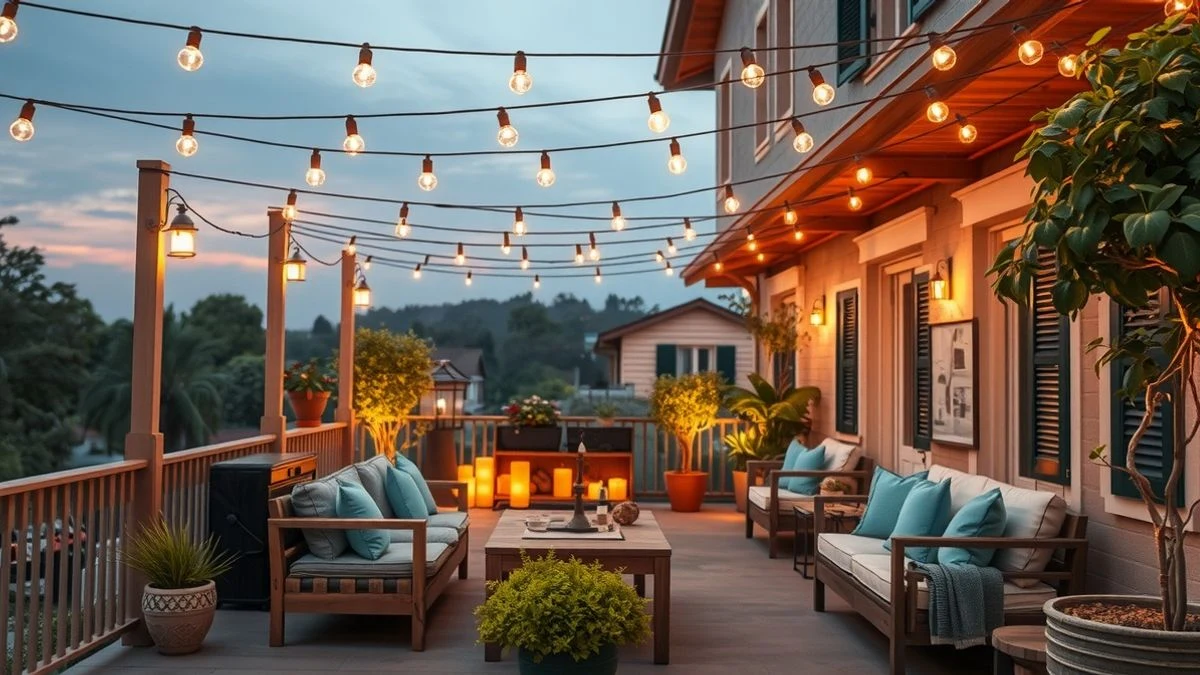
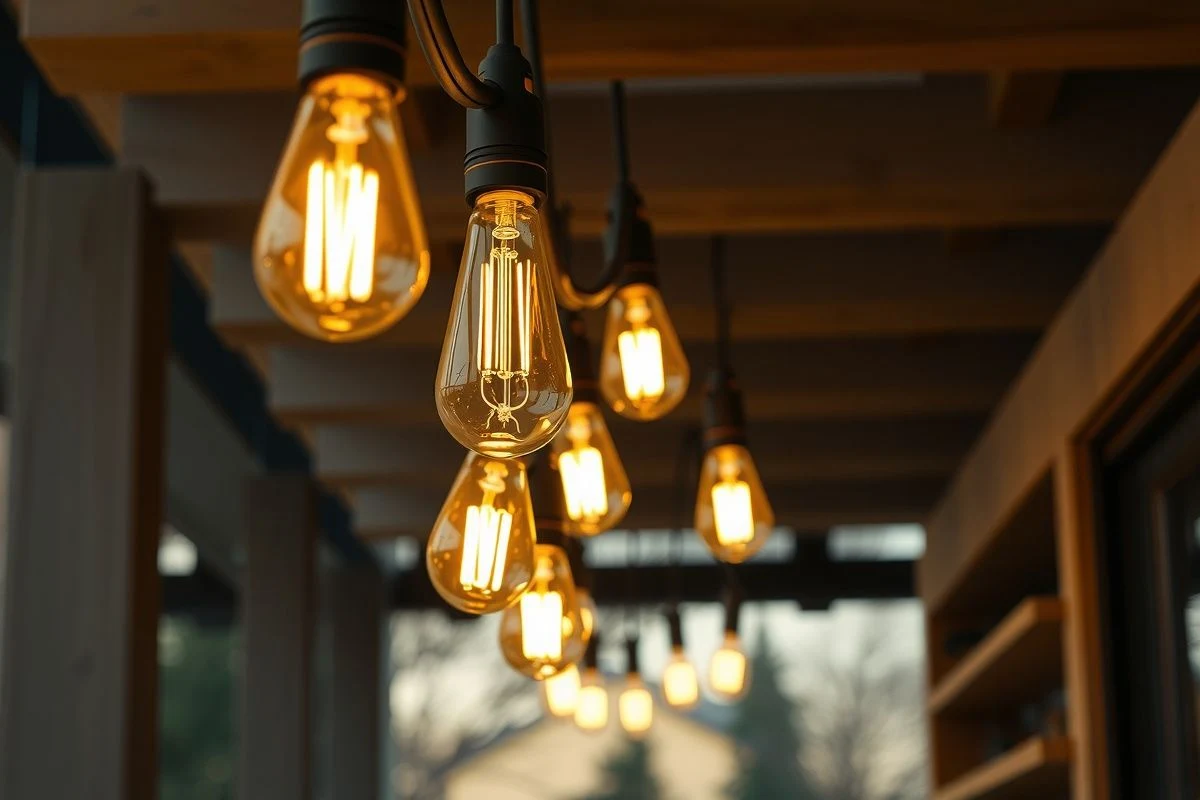
Ambient light is where the magic happens. This is where you place warmer, diffused lights that generate that cosy atmosphere we all seek. They can be decorative bulb garlands hung at a height of between 2 and 2.5 meters above the seating area, or auxiliary table lamps if you have a covered terrace. The colour temperature is critical: always opt for warm tones between 2700 and 3000 Kelvin, which recreate the light of a natural sunset and are infinitely more inviting than cold white lights.
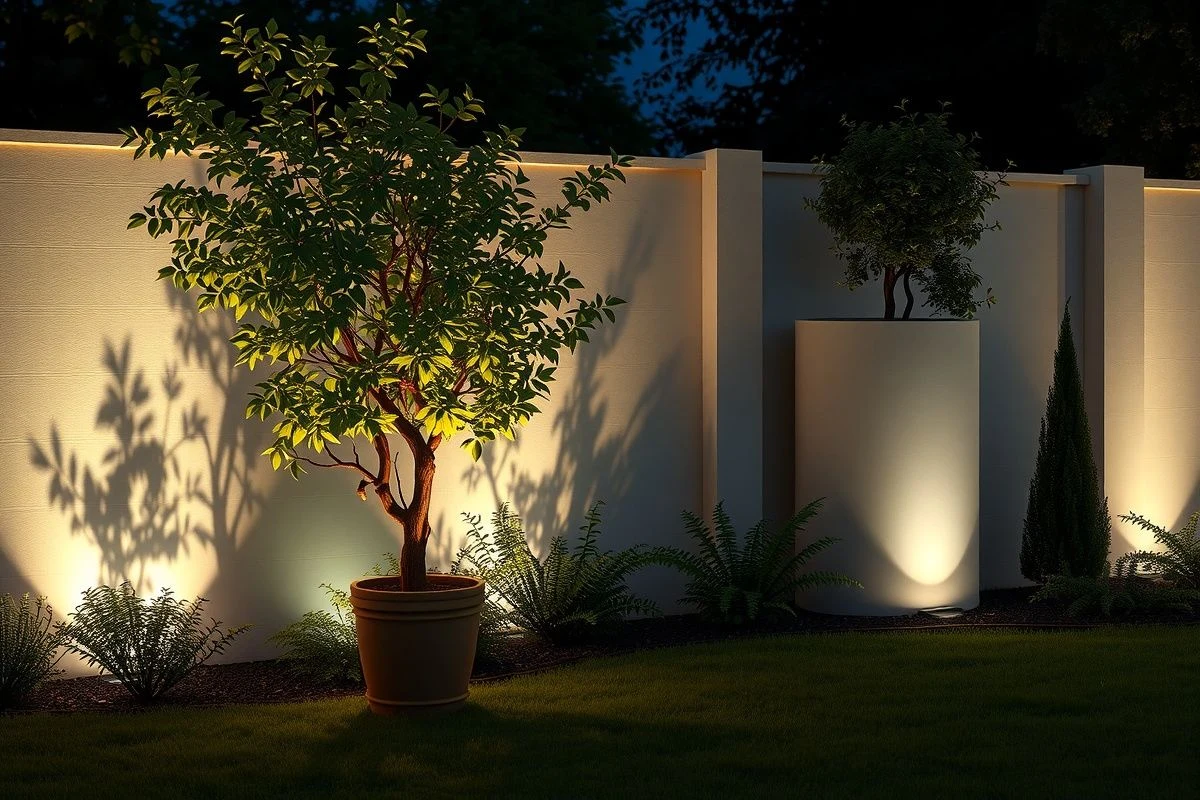
Accent light highlights plants, sculptures, textures, or boundaries of the space. A small recessed light in the ground directed at a large pot, or a mini spotlight aimed at a textured wall, creates visual depth and prevents everything from becoming flat and two-dimensional. These points of light can have between 100 and 200 lumens and provide that sophisticated touch that distinguishes a thoughtfully designed terrace from one illuminated "by default".
Smart Bulbs: Flexibility Without Compromise
Smart LED bulbs have revolutionised outdoor lighting. We can adjust the intensity from our mobile phones, change temperatures according to the time, and even programme scenes. If you have dinner on the terrace at nine, you can have bright, neutral light. At eleven, when you want a more romantic atmosphere, you lower the intensity to 40% and switch to 2200 Kelvin. It’s pure flexibility without having to touch a wire.
The trick is not to overdo it. You don’t need all your outdoor lights to be smart; having 2 or 3 strategic points is sufficient. The main sconces near the door, perhaps a garland of bulbs, and not much more. Accent lights can be fixed without any problem. Also, keep in mind that outdoor LED bulbs last between 25,000 and 50,000 hours, so you invest once and practically forget about maintenance.
A practical detail: make sure any smart bulb you use is waterproof and has at least an IP65 rating. This is not a luxury extra; it’s a guarantee that it will work after a summer storm without short circuits or electrical adventures.
Garlands and Tensioned Cable Systems
Decorative bulb garlands are probably the most versatile and affordable option for creating atmosphere. They extend lines of light over the entire seating area without requiring complex electrical installation. The ideal height is between 2.2 and 2.5 meters, high enough not to be visually intrusive but low enough to radiate light downwards and sideways.
If you have a rectangular or elongated terrace, two parallel cables work better than one. You’ll create a very enveloping “illuminated sky” effect. Our advice: space the bulbs apart to create a bit of shadow between them; it generates more visual movement than if they are all at the same intensity level. Spaces of 60 to 80 centimeters work perfectly.
Regarding the bulbs, filament bulbs are beautiful visually but consume more energy. LED options disguised as filament offer the best of both worlds: that warm, decorative look with minimal consumption. And if your terrace is small, a single garland of 3 to 4 meters already creates enough atmosphere.
Integrated Lighting in Architecture
Recessed lights in the ground, steps, or edges of planters require prior planning but offer the most sophisticated and clean result. They create lines of light that delineate spaces, guide movement, and add safety without being visually invasive. On polished concrete or the edges of decking, flush recessed lights are practically invisible during the day and magical at night.
If you don’t want to do any construction, there are portable alternatives: solar recessed lights that you can stake directly into the terracotta pot, or self-adhesive LED delineators for edges. They don’t have the permanence of a fixed installation but work surprisingly well for 6 to 8 hours after full darkness if they receive good daytime solar exposure.
Illuminated Plants: When the Garden Becomes a Gallery
Highlighting vegetation with direct spotlights is a trick that completely changes the perception of the space. A climbing plant illuminated from below casts its shadows on the wall and creates visual texture. A small tree with a spotlight at ground level pointing upwards generates drama. These light accents make your terrace look like a professional interior design project.
The ideal is to use concentrated beam spotlights, between 200 and 400 lumens, LED and adjustable. Place them 30 to 50 centimeters from the base of the plant. Experiment with angles: sometimes a lateral beam is more effective than a direct frontal one. If you use this resource on 2 or 3 strategic plants, you create points of interest that make the view meander through the space rather than remaining flat.
Colour and Temperature: Not All Whites Are the Same
Here comes the detail that no one tells you in stores but makes a real difference. The colour temperature completely affects how we feel in a space. A light at 4000 Kelvin (neutral white) is perfect if you need to work or cook on the terrace. But for relaxing after dinner, it’s harsh and unnatural.
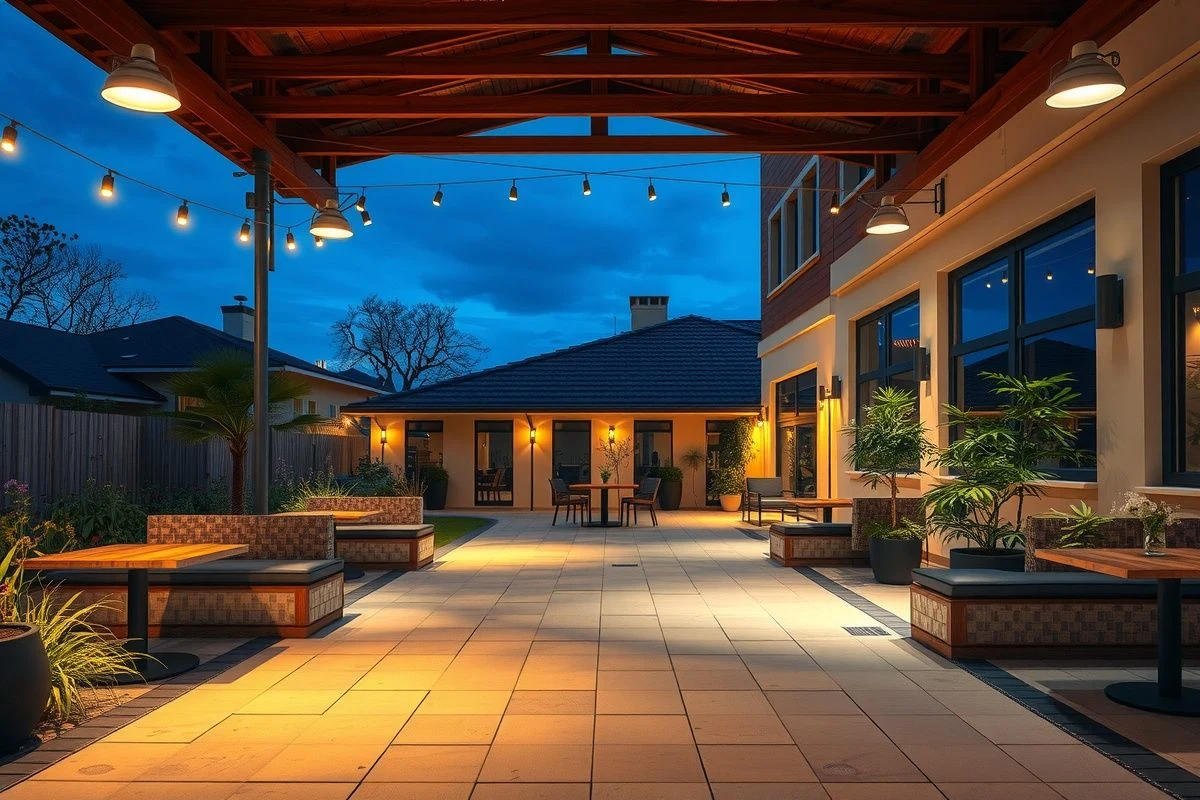
Our advice: use 2700 to 3000 Kelvin in all ambient light points. Reserve the 4000 Kelvin only for security sconces or hallway lighting. And if you really want sophistication, try tones of 2200 Kelvin in some intimate corner, that warm orange that resembles eternal sunset light. The difference is enormous and costs the same because we’re talking about LED bulbs.
Practical Distribution According to Space Type
In a small terrace (less than 15 square meters), with an adjustable angle main spotlight near the door, a 3-meter garland, and perhaps an accent spotlight on a large pot, you have enough. There’s no need to oversize. Sometimes less is more, especially when you’re looking for intimacy.
In medium or large gardens, the scheme changes. Here, illuminated paths with low lights every 2 meters work well, a seating area with its own layer of ambient light, and strategic accents. Mentally divide the space into zones: passage, dining, relaxation. Each has its specific lighting needs.
A garden with large trees is special: take advantage of the height. Lights suspended from branches or reflected in the canopy create depth. Trees are natural architecture that the right lighting turns into scenery. Don’t underestimate this potential.
Safety and Practicality
Finally, all the aesthetics in the world are worth little if they are dangerous. Ensure that all cables are elevated more than 2 meters or recessed to avoid tripping. If you use outdoor sockets, they must be at least IP54 rated and protected by a differential. This is not paranoia; it’s common sense when combining water, humidity, and electricity.
Programme lights with motion sensors in passage areas to avoid wasting energy, but keep seating areas always lit manually or automatically according to the time. And one last tip that has saved us more than one terrace: install a low-voltage switch or a centralised control app. Turning everything off from the sofa when you decide to come inside is pure luxury and absolute practicality.

You may also like