If there’s one thing we’ve learned at Casa y Deco, it’s that small dining rooms don’t have to mean compromise. An extendable table is the most practical solution to gain flexibility without sacrificing daily space: it allows you to comfortably dine with your partner or family on a daily basis, and when guests arrive or you celebrate a meal, you have surface area for everyone. It’s not just a decorative whim; it’s almost a necessity in homes with limited square footage.
The key is to choose wisely. Not all extendable tables work in small dining rooms: you need to consider the actual dimensions of the space, the extension mechanism, the material, and how it integrates with your kitchen and living room. I confess that the first mistakes we make when decorating tight spaces are not measuring correctly or thinking that any table will do. The consequences are disastrous: tables that don’t fit when expanded, or that take up so much space when extended that you can’t move around.
How Much Space Do You Really Need
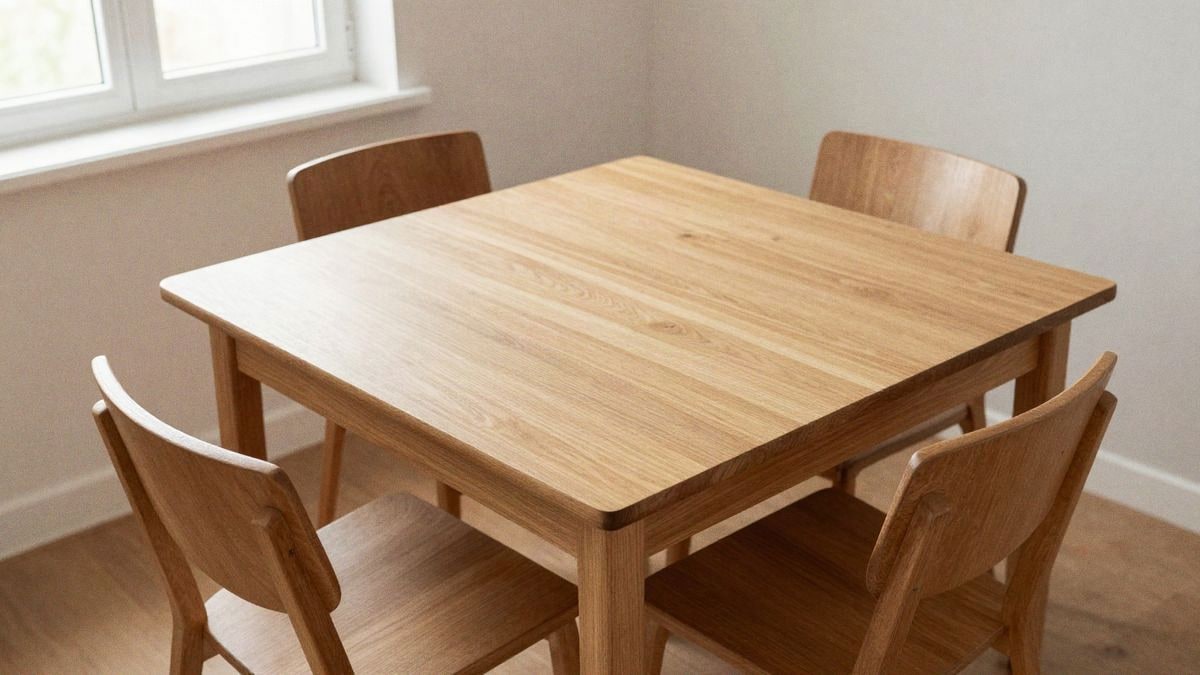
Before looking at catalogues, measure your dining room honestly. Measure the available width and length, and subtract 60 centimetres from each side if you want to be able to move comfortably around the table. Those 60 cm are the minimum needed to pass a chair, to pull in and out chairs without bumping into walls or furniture. If your dining room is only 2.5 metres long, forget about tables that expand to 2 metres: you’ll have no space left.
The standard measurements for a compact extendable table for four diners are around 120 to 140 centimetres long by 80 wide. When expanded, it can reach 180 to 200 centimetres, perfect for six or eight people depending on the mechanism. I confess that this saved my dining room: having that 40-60 cm difference meant I could host my sister without feeling cramped.
Another detail that often goes unnoticed: the space under the table. Some extension mechanisms leave an ugly gap or metal bars that get in the way of legs. Check how the extension unfolds: it should be clean and functional, without adding uncomfortable bulk under the surface. The best systems have the mechanism hidden and discreet.
Extension Systems: Each Has Its Charm
There are three main types of mechanisms, each with advantages and disadvantages for small spaces. The foldable wing extension is the most compact: it has leaves stored under the table that unfold upwards when you need to expand. It takes up less vertical space and is very effective, but requires a bit more skill to store and unfold. If your dining room is open to the living room and kitchen, this system is your ally.
The central extension system with additional tabletop is the most common. The table opens in the middle and accommodates one or two rectangular leaves that increase the length. It’s intuitive, easy to use even with guests who haven’t tried it, and allows for considerable expansions. The downside is that you need space to store those leaves when not in use: think about where you’ll place them, because that’s the real challenge in a small flat.
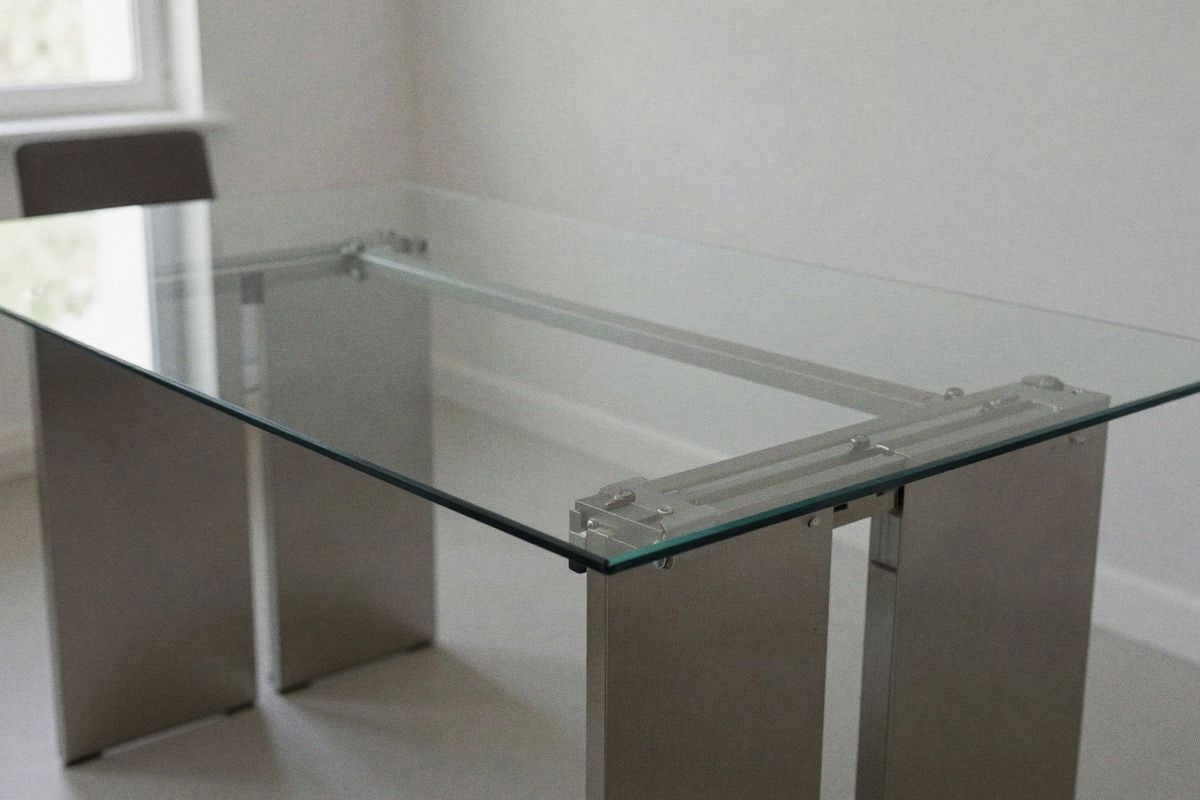
Finally, there are glass tables with a steel or tempered glass base, which have an almost magical invisible mechanism. They expand without added leaves; the sides simply separate and the tabletop stretches. They are expensive, take up less storage space, but are delicate and require extra care if there are small children at home.
Materials That Work in Compressed Spaces
The material you choose affects not only durability but also how the dining room looks. Solid wood is warm and adds character, but adds visual bulk. If your dining room is already small, a dark oak or walnut finish can make it feel more claustrophobic. Opt for lighter tones like pine, beech, or cherry, which consume less light and space.
Glass and steel are your best allies if you want spaciousness. A tempered glass table with polished steel legs looks almost floating and doesn’t steal visual presence. In dining rooms of less than 15 square metres, this combo is practically magical: the transparency deceives the eye and the space seems more generous. However, it requires constant cleaning and is not compatible with anything other than very smooth tablecloths.
If you prefer a middle-ground solution, tables with a glass top and a light wood base combine warmth and lightness. You have the wood that gives that more organic touch, but the glass maintains the sense of space. Lightly stained wood bases in off-white or natural tones work especially well with Nordic or contemporary decorations.
Colours and Finishes That Don’t Tire
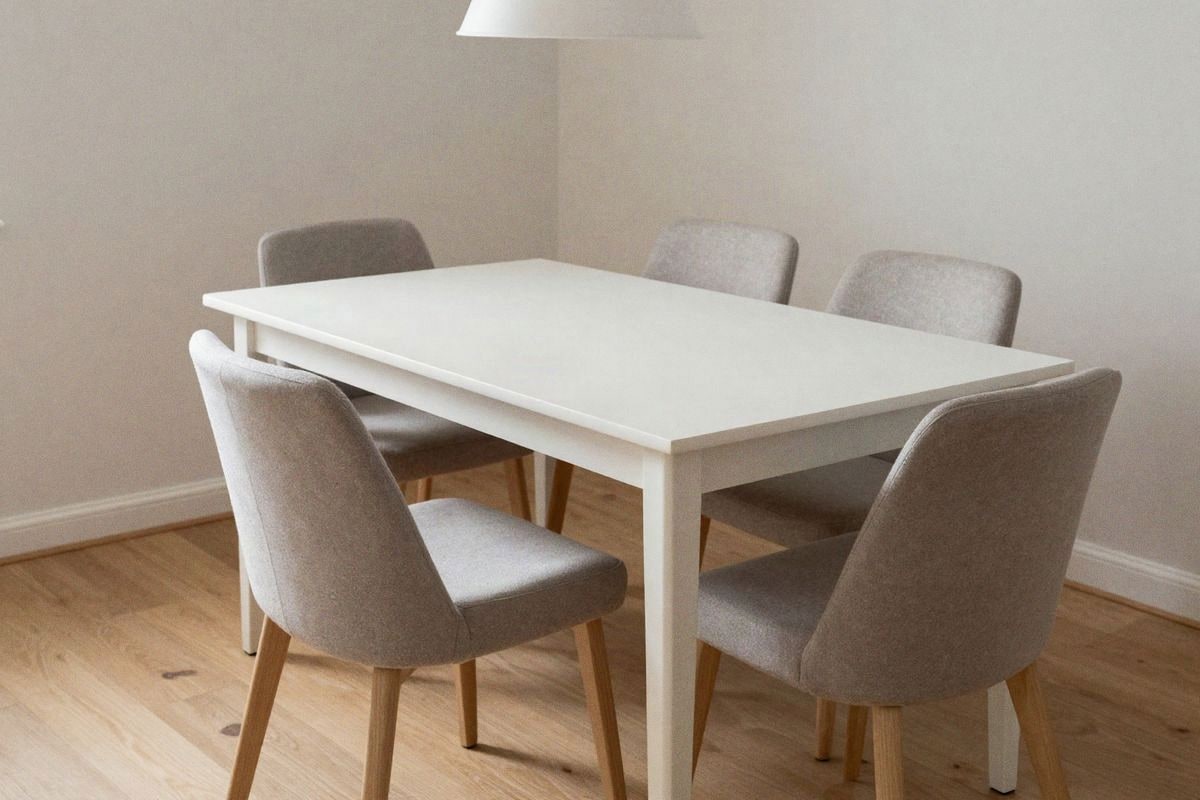
White and beige are classics for small dining room tables for reasons beyond fashion. These neutral tones don’t compete with the rest of the decor, amplify natural light, and make the space breathe. At Casa y Deco, we’ve seen how a greyish dining room with a white light wood table completely transformed the perception of size.
If you want something with more personality without losing spaciousness, light greys and warm tones like very pale salmon work well. They are neutral enough not to overwhelm, but have more soul than pure white. Avoid tables in very dark, saturated tones or with overly marked patterns if your dining room is truly small: the golden rule is that it shouldn’t compete with other elements.
As for finishes, matte lacquers absorb less light than glossy ones and give a more sophisticated touch. A matte finish is more discreet, while a glossy finish creates reflections that can be tiring in enclosed spaces. Woods with satin varnish are the perfect middle ground: with natural shine without overdoing it.
Accessories That Enhance Functionality
Once you have chosen the table, the details multiply its effectiveness. Removable or stackable chairs are your best investment: they take up a fraction of the space when stored and allow for more seating when you need it. Metal “Tolix” chairs or stackable Scandinavian design chairs are both beautiful and functional. Don’t store all the chairs in the dining room: place two or three in the space daily and the extras in a nearby room or under a console.
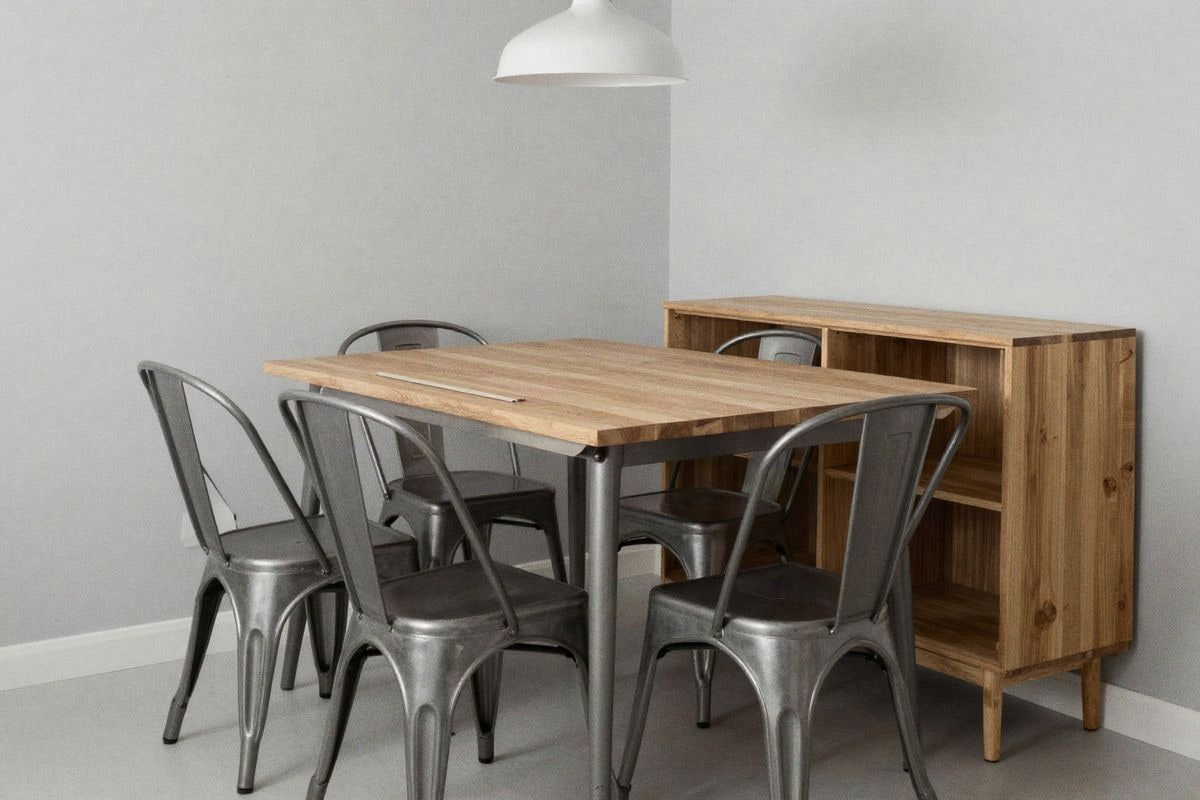
A sideboard or buffet complements the table in small spaces. It serves as storage for napkins, glasses, tablecloths, and also helps serve meals more comfortably. Look for one with a standard height of 85-90 cm, a depth no greater than 40 cm to avoid blocking the way, and a width of 120 to 150 cm. A white, natural, or grey sideboard integrates perfectly with a neutral extendable table.
Lighting is crucial and often forgotten. A good pendant lamp over the table enhances the sense of vertical space and marks the dining area without the need to close it off with walls. Look for one that hangs 60-70 cm from the ceiling, with an open shade so it doesn’t darken the area. Metallic or light wood materials work better than heavy or very dark ones.
Errors You Must Avoid at All Costs
Don’t buy a table without checking that the mechanism works smoothly and quietly. A noisy or hard-to-handle extension system ends up being pure frustration, especially if you have to deploy it frequently. Test it in the store, make full movements, check that the leaves fit well and that it doesn’t jam.
Don’t sacrifice quality to save centimetres. Better a smaller table but with good material and good extension than a cheap one that won’t last three years. Dining tables are protagonists and are used daily: a moderately solid investment is more cost-effective than having to replace it every two years.
And I confess that we are not at all convinced by excessive accessories on small tables. Avoid very bulky table linens, large centrepieces, or accessories that steal space. Less is more when the table is small: a candle or a simple bouquet is enough to create atmosphere without taking away useful centimetres.

You may also like