At Casa y Deco, we know that how to organise a small wardrobe is one of the most common decorative challenges in Spanish homes. It's not magic nor having a wardrobe from a movie: it's pure strategy. That limited space where barely today's clothes fit and you don't know where to put tomorrow's has a solution, and I swear that once you do it, you will be amazed at how much your relationship with your own wardrobe changes.
The first and most important thing: you have to tackle this without half measures. Take a weekend, put on some music if it helps you stay in a good mood, and take out ALL the clothes you have. Yes, all of it. Don't leave anything hidden in other boxes, drawers, or bags. Bring it all to the bedroom, the living room, wherever. You need to see the real volume of what you own. This may seem like a temporary chaos; I confess that this saved my living room because at that moment I realised how much clothing I had accumulated that I didn't even try on.
Once you have everything in front of you, it's time to sort. This step is mandatory if you want the small wardrobe to work. Make three piles: one with the clothes you actually wear and that fit you well, another with what you clearly don't wear (be honest with yourself, that blouse you can't match with anything needs to go), and a third with items that need fixing. The first two are the most important. What you don't wear takes up space you don't have. It's simple space mathematics.
After decluttering, organise by categories. Keep trousers together, t-shirts together, dresses together, and underwear in its place. This makes it easier to find things and you can see at a glance what you have of each type. If your small wardrobe is between 1.5 and 2 metres wide, you probably have about a third of depth, so every centimetre counts.
Storage Systems That Maximise Space
We are not convinced at all by small wardrobes without internal organisation systems. Normal rods leave half of your clothes hanging in the air. You need accessories that multiply your space.
Double or triple hangers are your friends. You can stack several garments on the same hanger (be careful not to make it too heavy). Some models have cascading clips that allow you to hang trousers, skirts, or t-shirts one below the other. You gain verticality without taking up width.
Internal drawer organisers work well if your wardrobe has space at the bottom or sides. Separate underwear, socks, and small accessories into compartments. This prevents everything from mixing and saves you from throwing in the towel when searching for a belt lost three months ago. There are foldable fabric boxes that are inexpensive and take up little space.
For folded clothes, storage cubes between 30 and 40 centimetres high fit well in narrow wardrobes. Place t-shirts, sweatshirts, or jumpers vertically inside (the Kondo method is still valid). You can see what you have without having to pull out the entire pile. And they don't get wrinkled like when you stack them haphazardly.
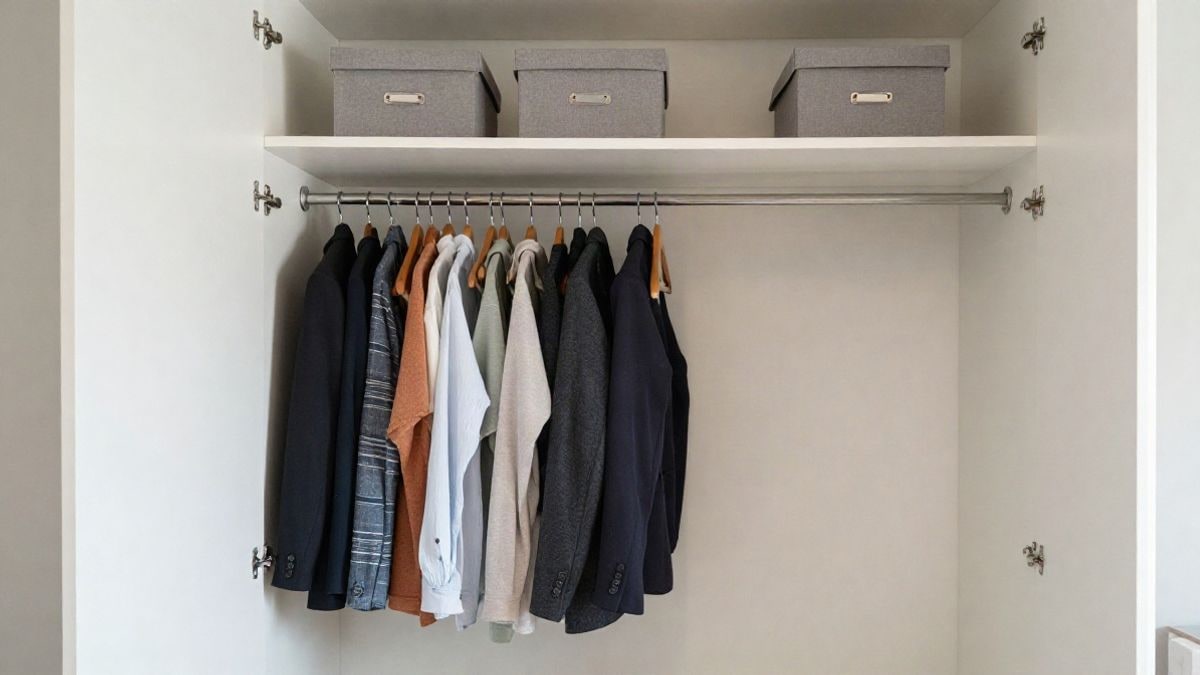
If you have shelves instead of rods, take advantage of them. A shelf can hold two or three storage boxes. If your wardrobe has adjustable rods, reorganise them as needed: more space at the top for coats in winter, or redistribute according to your current collection.
Colours, Visual Order, and Maintenance
Here comes something that many overlook: visual order helps a lot with how to organise a small wardrobe. Hang clothes in colour order: darks, earth tones, lights. It's not just for aesthetic vanity (well, maybe a little), but because this way you find what you're looking for faster. Your brain processes colour patterns better than words.
Neutral colours in hangers help. Avoid distracting coloured hangers. Wooden or grey metal ones look more serious, less chaotic. It's a small change, but visually and mentally it makes the space seem more organised.
Every time you take out clothes, leave the hanger on the opposite side. At the end of the month, whatever remains on that side... you know what to do. It's the turned hanger method. You don't need to do a purge again: just identify what you don't use in your real life flow.
Finally, the most boring but most effective: a weekly maintenance of five minutes. When you hang clean clothes, make sure the hangers are still in place, and that nothing is hanging messily. Small wardrobes look chaotic quickly if you let the clothes fall as they please.
If your wardrobe is really tiny, consider also utilising the inside of the door. There are fabric organisers with pockets that hang from the rod. Perfect for accessories, belts, or scarves. It's not much extra space, but in a small wardrobe, every corner counts.
The key is that organising a small wardrobe is not a mysterious art. It's about discarding what you don't use, choosing systems that multiply your vertical space, maintaining visual order, and doing small but regular maintenance. Once you do it the first time, you will see that your wardrobe really works. And that, believe me, changes your day-to-day life a lot.

You may also like