At Casa y Deco, we always say that the rug is the great forgotten element of the living room: everyone buys one, but few measure it carefully. And that's where the trouble begins. How to choose the size of a rug for the living room is one of the most common questions we receive, and the short answer is that it depends on the furniture you have, not on what’s trendy this year. We confess that we also made a mistake with the first rug in our own living room, which ended up under the sofa as if it were a luxury doormat. So let’s review the measurements that actually work.
Start with the Sofa, Not the Rug
Before looking at catalogues, grab a tape measure and measure the sofa, the coffee table, and the free space you have between the wall and the nearest piece of furniture. How to choose the size of a rug for the living room always starts with this simple calculation: the rug should serve as a base for the whole set, not float in the middle of the room like a patch.
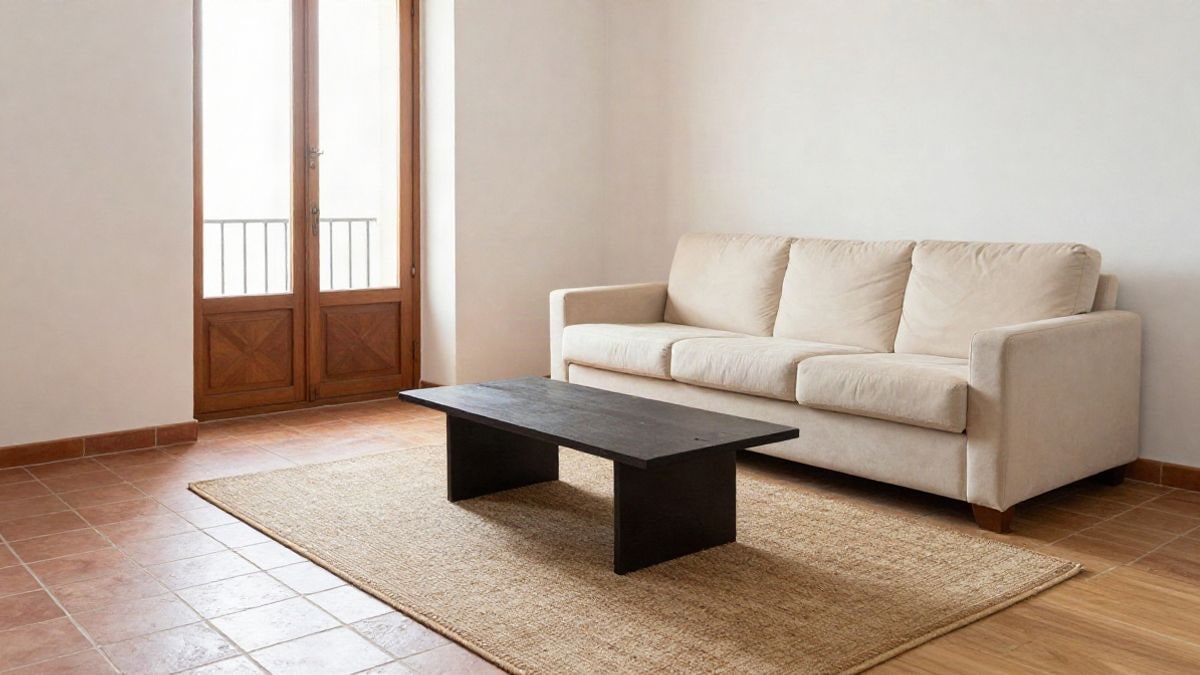
There are two classic ways to place it. The first is that all the front legs of the furniture are on it. The second, more elegant and commonly used in spacious living rooms, is that the sofa and chairs rest entirely on it. If the room is small, the second option visually enlarges the space. If it’s large, the first allows you to use a more economical rug without it looking like something is missing.
Standard Measurements and When to Use Each
Rugs are manufactured in quite common sizes, so it’s good to know them before heading out shopping. The most common are 160 x 230 cm, 200 x 290 cm, and 240 x 340 cm. There are also 120 x 170 cm rugs and, for very large living rooms, 300 x 400 cm.
The 160 x 230 cm rug works well in small living rooms or with a two-seater sofa, as long as the coffee table fits on it. For a three-seater sofa and a medium-sized table, the 200 x 290 cm is the most balanced option and the one we recommend the most in city flats. If the living room exceeds 25 square meters or you have an L-shaped sofa, the 240 x 340 cm is the only one that can gather the whole set without leaving corners hanging.
A practical rule: the rug should extend about 30 to 40 cm on each side of the sofa. This way, it feels like the set is designed as a whole and not as separate pieces.
How Much Space to Leave Around
This is the point where most people fall short. A rug that is too small leaves a visible ring of floor around the furniture, and that effect makes the living room feel smaller. Ideally, leave between 30 and 50 cm of free floor between the edge of the rug and the walls. Less than 20 cm tends to feel cramped, and more than 60 cm makes the rug seem lost.
In hallways or passage areas, ensure that the edge is about 50 cm from the doors so it doesn’t get caught when opened. And if you have a radiator, measure carefully: it’s common to leave a gap of about 10 cm for heat circulation so that the wool doesn’t get damaged.
If the Living Room is Also a Dining Room
When the dining table shares space with the sofa, the rug has to handle an extra task. Here the key is to calculate the space taken up by the chairs when someone gets up. It’s advisable for the rug to extend about 60 cm beyond the edge of the table in all directions, so that the chair legs don’t fall off the edge when pulled back.
If your table is round, a round rug of 180 to 200 cm looks very harmonious. With rectangular tables, a rectangular rug is logical, although an oval rug also works very well in irregularly shaped living rooms.
Shape, Material, and Small Details
Size is key, but shape and material also play a role. Rectangular rugs are the most versatile and best suited for linear sofas. Round rugs soften spaces with many straight lines, and jute or natural fibre rugs add texture without imposing colour. If your living room has a lot of foot traffic, opt for wool or high-density synthetic blends, which are easier to clean and maintain their shape.
Don’t forget about thickness either. A very thick rug can make it difficult for chairs to slide, and one that is too thin may wrinkle if stepped on often. As a guideline, short-pile rugs with medium density are the most practical for everyday use.
Common Mistakes We See (and Have Made)
The most repeated mistake is buying based on price or colour without measuring. We’re not convinced by a beautiful rug that doesn’t fit in the living room, nor by those that end up in the middle of the room like a lost island. The second mistake is placing it without viewing it from the entrance: before fixing the position, walk around the living room and see how it looks from the door.
A final piece of advice, one we learned the hard way: if you’re torn between two sizes, choose the larger one. A rug that is too small is always noticeable, while one that is slightly generous tends to go unnoticed and gives the living room a well-resolved feel. And if after measuring you’re still in doubt, get a painter’s tape, mark the dimensions on the floor, and live with it for a few days. We did this and it saved us from more than one disappointment.

You may also like