At Casa y Deco, we love when a headboard completely transforms a room, but we also know what happens when one is purchased thoughtlessly: the bed looks tiny, the furniture blocks half a window, or the backrest ends up at pillow height. That's why, before choosing a model, it's essential to resolve the age-old question: what height should a headboard be. The short answer is that it depends on the bed, the ceiling, and how much space there is between the mattress and the ceiling, but there are quite reliable guidelines to get it right the first time.
The basic rule: it should extend above the mattress
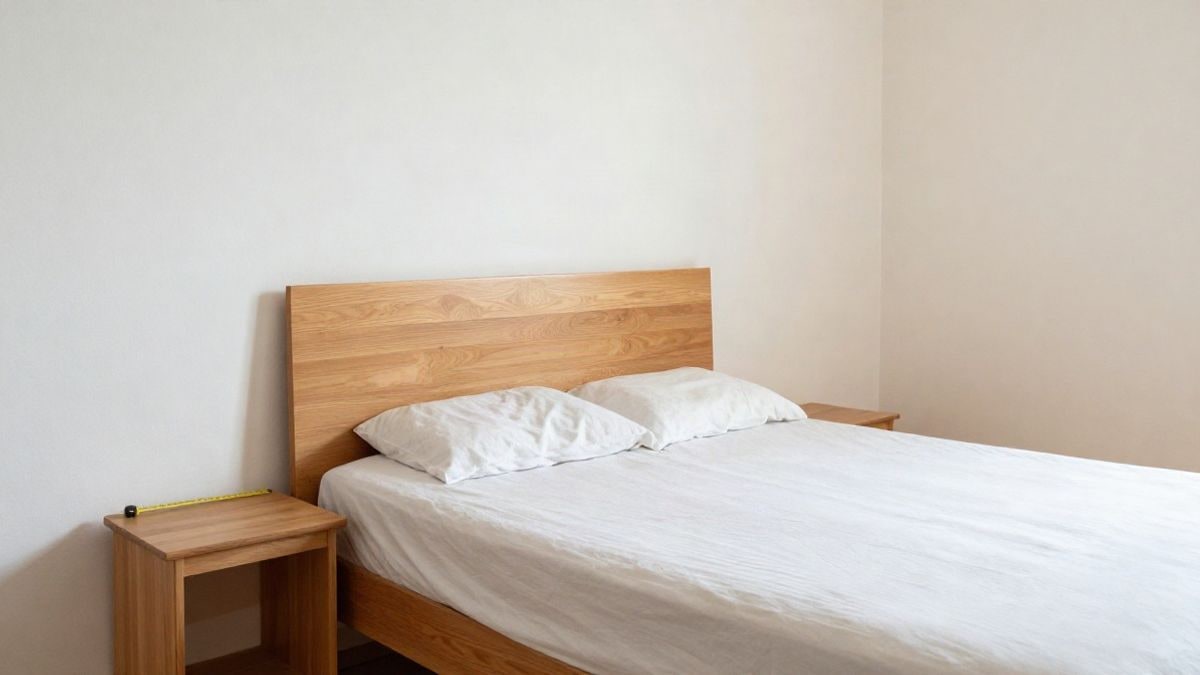
The starting point is simple. The headboard must be taller than the mattress, pillows, and cushions, so that these do not end up hidden behind it. Typically, it should extend 30 to 40 cm above the mattress surface. With this measurement, when you sit down to read or look at your phone, you have a comfortable backrest, and the furniture appears as a design element rather than just a board leaning against the wall.
I confess that the first time I measured at home, I made a mistake. I bought a headboard that seemed tall in the store, and when I got home, it was at pillow height. With the bed made, it looked like a baseboard. I returned it without a second thought, and since then, I always take a tape measure to the store, even if they look at me strangely.
Another way to look at it is to think of the mattress as the starting point. If the mattress and base together are about 50 cm from the floor, a headboard of 80 to 90 cm in total height will leave the backrest at a very comfortable height, without covering the pictures or wall lights that usually go above the bed.
Total height from the floor
If you prefer to think in total measurements, the most commonly used reference is the highest point of the headboard measured from the floor. They are usually grouped into three categories:
- Low headboard: between 90 and 110 cm. Fits well with beds with little mattress or in bedrooms with low ceilings, and leaves the wall quite clear.
- Medium headboard: between 110 and 135 cm. This is the most balanced option for most double beds, as it provides presence without being imposing.
- High headboard: between 135 and 160 cm. Adds a lot of character and works when the ceiling is high and the wall has no windows or doors that interrupt the whole.
These figures are indicative. A bed with a raised base or a 30 cm mattress significantly changes the outcome, so the measurement that truly matters is the one obtained by subtracting the actual height of the mattress from the highest point of the headboard.
How bed size influences height
A 135 cm bed is not the same as a 180 cm bed. In narrow beds, a very tall headboard can overwhelm the wall and make the whole look smaller, so in those cases, it’s best to choose a simple model, with straight lines and a width adjusted to that of the bed, without extending over the sides. As a rule, the headboard should not excessively exceed the width of the mattress, as the result appears unbalanced.
In beds of 150 or 160 cm, the margin is greater, and you can play with slightly taller headboards or those with volume in the upholstery. If your bed is 180 cm or more, the headboard becomes more prominent and needs space. Here, it’s worth considering the entire wall: sometimes a panel that covers the full width, with a contained height, works better than a tall but narrow headboard that appears to float.
The ceiling and proportion with free space
The ceiling also plays a role. A practical rule is that the headboard should occupy approximately one third of the space between the mattress and the ceiling. Let’s take an example: if the ceiling is 2.50 m high and the mattress, with the base, reaches 50 cm from the floor, the usable space is around 2 m. One third is about 65 cm, and that would be the height above the mattress that would keep the proportions balanced. If the model you like exceeds that figure, it’s wise to carefully consider how it looks before purchasing.
In bedrooms with low ceilings, the idea is the opposite: less height and more width. A low and wide headboard helps the bed not to appear squashed, and light tones on the wall enhance the sense of spaciousness.
Height and design: what deceives the eye
The actual height is not the only thing perceived. Design greatly alters the sensation. A headboard with vertical slats stretches the wall and gives an impression of height, while horizontal slats widen the space. Slatted headboards, so linked to Nordic style, add depth, although if the slats are too close together in a small bedroom, they can overload the view more than it seems.
Upholstery also deceives. A padded model with pronounced tufting looks bulkier than a smooth one of the same size. If space is tight, a thin upholstery in a tone similar to that of the wall is the most discreet option. And if you like wood, light finishes like oak or natural pine usually lessen visual weight.
How to measure before buying, step by step
Buying from a photo is the number one mistake. In catalogues, the headboard always seems lower because the bed is in a studio with very high ceilings and lighting that has nothing to do with your home. My advice is to follow this process before paying:
- Measure the height of the mattress from the floor, with the base in place, and note it down.
- Measure the distance from the mattress to the ceiling and calculate one third of that space.
- Mark with painter's tape on the wall the height the headboard will have, with the actual width of the bed.
- Check sockets, wall lights, pictures, and windows that are at that height or nearby.
With the tape on the wall, you can see it in five minutes. I did it in my bedroom and discovered that the bedside socket was right behind the area where the headboard was going. A detail like that can ruin an entire project.
Common mistakes and how to avoid them
Besides buying from a photo, there are other recurring mistakes. The first is forgetting the bedside tables. If you place tables of 55 cm under a headboard of 90 cm, the proportion may work, but if the tables are very tall or have long legs, the headboard appears sunk into the wall.
The second is choosing a dark colour without considering the light. A black or very dark walnut headboard in a bedroom with only one window can make the room feel smaller. In that case, balance it with light textiles and a well-placed lamp.
The third is allowing the headboard to touch the floor in a very tight space. If the wall is narrow or the door is close, a model that reaches the floor limits passage and forces you to move sideways. A floating model or one hung on the wall is usually more practical, plus it makes cleaning underneath easier.
And one last detail, which I found hard to learn: headboards with storage or integrated shelves need more depth than it seems. Before deciding on the height, check that you won’t bump your head when getting up if the shelf is too close to the mattress. My cat also has an opinion on the headboard, but his criterion is to sit on it, so we ruled that out as a reference.
What changes according to the use of the bedroom
Also think about how you use the bed. If you only sleep in it, a backrest between 30 and 40 cm above the mattress is more than sufficient. But if you read, work with your laptop resting on the headboard, or like to sit up straight to watch a series, you need it to be taller and, above all, sturdy. In that case, prioritise a firm structure and upholstery that can withstand wear.
The budget also plays a role, although not always in the expected direction. A simple and well-measured headboard often looks better than an expensive and poorly proportioned one. The height is the first thing noticed upon entering the room, and no finish can compensate if the proportion is off.
The practical answer
In summary, the ideal height for a headboard is usually between 30 and 40 cm above the mattress, adjusted to the size of the bed and the free space up to the ceiling, with the wall as the final reference. If you measure beforehand, mark with tape, and check for obstacles, it’s very hard to go wrong. And if in the end you’re torn between two heights, stick with the lower one and observe the room for a few days: if the bedroom feels calmer, you’ve got it right.

You may also like