If there's one thing we've learned at Casa y Deco, it's that a lack of natural light doesn't have to be an excuse to give up on plants. I confess that a few years ago I thought exactly the opposite: I believed that without direct sunlight, it was impossible to keep any corner green. Then we discovered that there are real plants —not the typical plastic ones we all have stored away in some cupboard— capable of thriving in dark spaces, in windowless hallways, in bathrooms with little light, or in those bedrooms where natural light is a rarity. Today, we share all the secrets we've accumulated to turn those gloomy spaces into little oases of greenery.
Before choosing any plant, it's important to understand what "without light" really means. We're not talking about total darkness —because no plant, absolutely none, can live without light for weeks— but rather spaces where direct sunlight doesn't reach, yet there is artificial lighting or diffuse brightness during the day. A room that receives light from a distant window for eight hours, even if it's indirect, already offers sufficient conditions for many species. The crucial difference lies in lumens: while a sun-loving plant needs 1,000 to 2,000 lumens, shade-tolerant plants are content with 200 to 500.
Tested Plants That Grow Without Direct Sunlight
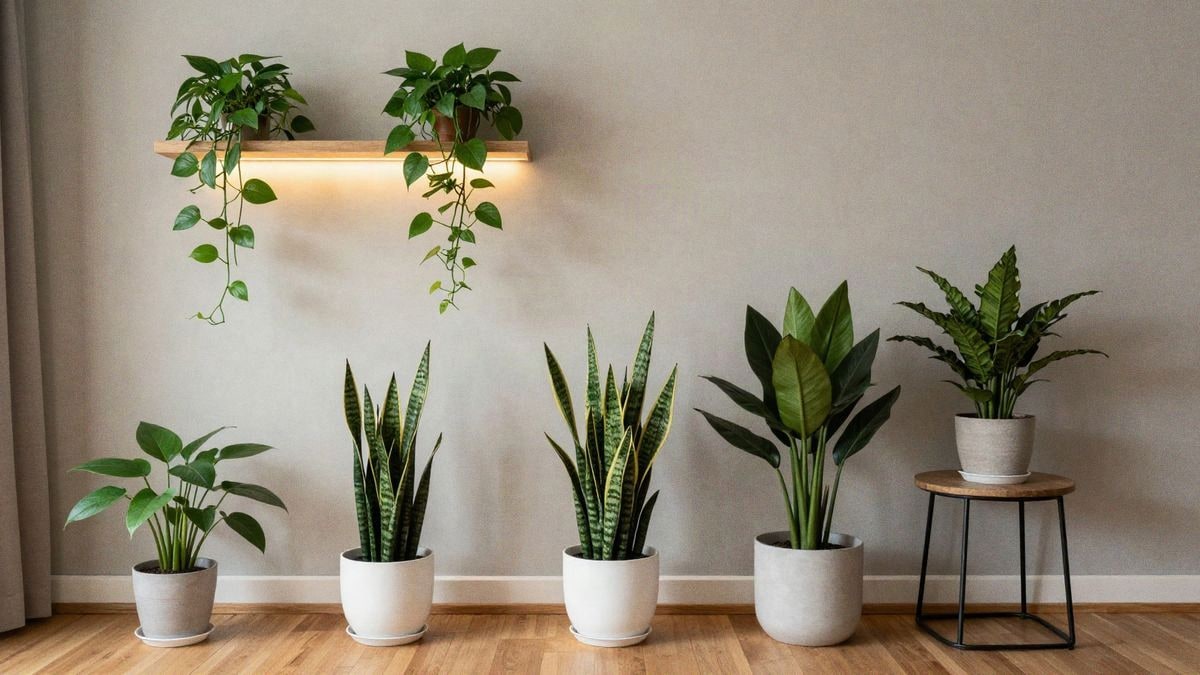
The Pothos —also known as epipremnum or devil's ivy— is possibly the undisputed queen of dark spaces. It has a slow but steady growth, its leaves are a vibrant green, and it fits into any corner without pretensions. The best place to put it is on a floating shelf about 150 centimetres high, where its stems will naturally cascade, creating a visual waterfall that also hides cables and other imperfections. We've seen pothos thrive in windowless hallways for years, needing just a watering every ten days in winter and every five in summer.
The Sansevieria, that plant with elongated, pointed leaves that almost seems decorative by intention, is indestructible. They tolerate extreme dryness, lack of light, and even periodic neglect. They are perfect for small bathrooms without windows, on hallway shelves, or on side tables in dead corners of the living room. They grow slowly, which means you won't need to repot them every six months. A watering every three weeks is more than enough. Their vertical structure makes them ideal for narrow spaces: they take up little floor space but generate immediate visual presence.
The Aspidistra is a classic that our grandmothers already knew, and for a reason: it works. Its large, robust leaves have a natural appeal, although I confess I didn't think they were the panacea until I saw them in a friend's dark room. There they were, without drama, but completely alive, adding that green touch that makes a difference. They need moderate watering, about every two weeks, and appreciate a humid environment (which is why they work especially well in bathrooms).

The Aglaonema or Chinese money plant combines two advantages: it tolerates shade and its leaves have very attractive colour patterns —silver, red, or cream tones on a green background—. They are compact, grow slowly, and add a more decorative touch than monotonous plants. One tip: place them no more than two metres from a light source (window or lamp), because although they tolerate shade, a bit of indirect light makes the colours of their leaves more vibrant.
Plants for Really Dark Spaces
If your room is so dark that the previous plants might struggle, the Areca Palm is a valid option, although it requires more care than the others. The key is to provide it with sufficient artificial light: a 40-watt LED lamp placed 60 centimetres away for 12 hours a day may suffice. It seems like a lot, but nowadays you have countless decorative options: from recessed light panels in shelves to strategically positioned desk lamps. The energy cost is minimal compared to incandescent bulbs from ten years ago.
The Dwarf Ficus Lyrata is another alternative for dark spaces, especially if you want something with more visual presence than a small succulent. Its leaves are broad and attractive, although it will grow more slowly without natural light. Don't overwater it: wait until the substrate is completely dry before re-moistening. The most common mistake with this plant is overwatering, which leads to root rot and can kill it in a few weeks.
The Fundamental Role of Artificial Lighting
Here comes what really makes it possible to have living plants in rooms without natural light: the right artificial lighting is an absolute game changer. You don't need special full-spectrum bulbs —which exist and work, but are expensive—. Neutral temperature white LEDs (4000-5000 Kelvin) work perfectly well. Intensity and duration matter more than the type: a plant typically needs between 12 and 14 hours of light a day, regardless of whether it's natural or artificial.
Our favourite trick is to install small recessed light panels in the shelves. They take up almost no space, generate little heat, consume a ridiculous amount of electricity, and transform a dark corner into a small vertical garden. If you prefer something more accessible, a black or silver LED desk lamp can be placed on a piece of furniture in such a way that it lights the plants without you seeing the bulb directly. The goal is for the light to come from above or slightly from the side, mimicking the sun's position as closely as possible.

Specific Care in Spaces Without Natural Light
Watering in the absence of direct sunlight requires greater caution. Without sun to speed up evaporation, the substrate stays moist longer, and the risk of rot increases dramatically. The rule is simple: water less frequently than you would in a bright area, and always check that the substrate is dry in the top 3-4 centimetres before adding more water. In winter, some spaces without natural light are even colder, which further slows evaporation.
Fertilisation also changes. Without abundant light, plant growth is slower, so they need fewer nutrients. During the dark winter months, many plants practically hibernate: stop fertilising completely and reduce watering. In spring and summer, a diluted liquid fertiliser every two or three weeks is sufficient. Forget the amounts indicated on the packaging; with low-growing plants, less is always more.
Humidity becomes important in enclosed spaces without natural light. These places tend to be drier than you might think, especially if there is heating. A simple trick is to group the plants together in one area: they create a more humid microclimate among themselves. Another option is to place a small humidifier —ultrasonic ones are silent and economical— that maintains humidity between 50 and 60%, a level that most indoor plants deeply appreciate.
Distribution and Aesthetics: Making It Work Visually
Having plants in dark spaces is not just a matter of botanical survival, but of how you place them and combine them with your decor. A single small plant in a large room goes unnoticed; grouping three or four of different heights and textures creates real visual impact. Our approach is always to think in levels: a tall sansevieria on the floor, a hanging pothos at one and a half metres high, and a compact aglaonema on a shelf at 80 centimetres. This occupies the same floor space but looks much more generous.

The colour of the pot is crucial when light is scarce. Light tones —white, cream, light grey— reflect the little light available, making the area visually brighter. Dark pots, although elegant, absorb light and can make an already dark corner seem even gloomier. If your decor calls for dark tones, alternate: a black pot for the main plant and two white or natural pots for the secondary ones. This creates visual contrast and allows the whole arrangement to breathe.
Don't forget to clean the leaves. Without intense natural light, the dust that accumulates on the leaves is more visible, and it also blocks the little light they receive. Once a month, use a soft sponge dampened with warm water to clean large leaves —pothos, ficus, aspidistra—. For plants with many small leaves, a light shower under the tap works better. Clean plants not only look better; they absorb the little available light much more efficiently.
In conclusion, spaces without natural light are not enemies of plants: they are simply a different challenge that can be solved by combining the right species, strategic artificial lighting, and adjusted care. We have repeatedly proven that a dead hallway can become a small green garden with just a few metres of investment in LED lights and a handful of shade-tolerant plants. The important thing is to start: choose a species, place a soft light, and watch. Plants are surprisingly resilient when you understand what they really need.

You may also like