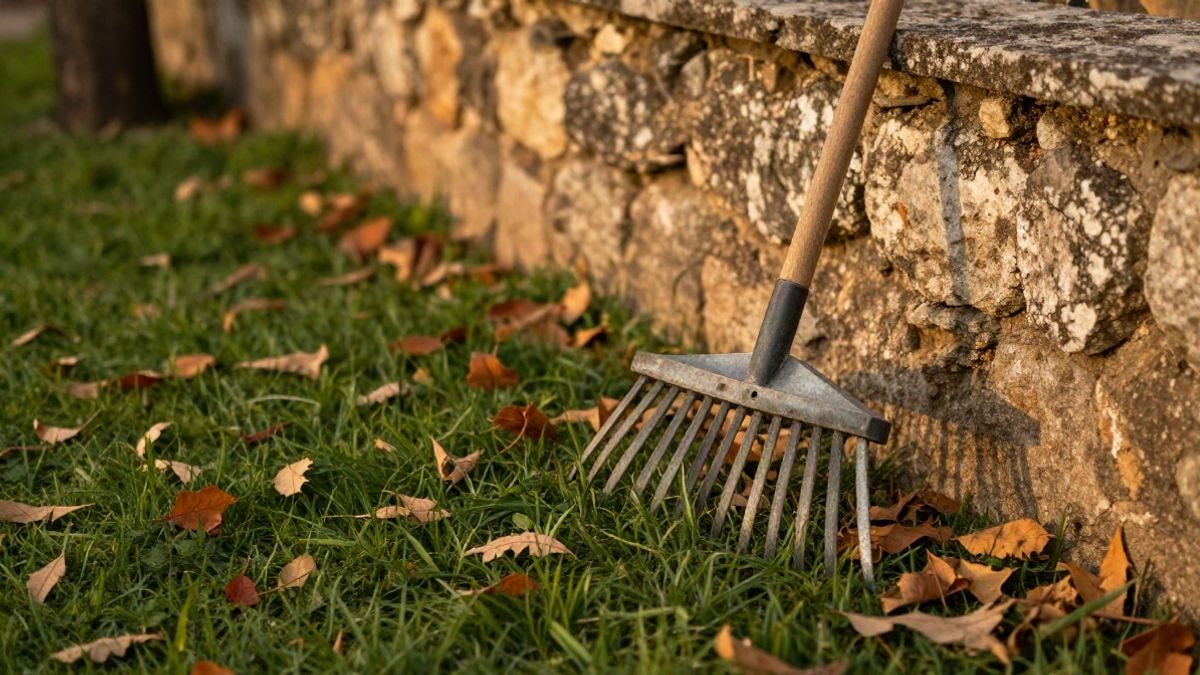
At Casa y Deco, we love to see the garden change colour, but we also know that autumn is the season when lawns are most neglected. As the heat fades and the days shorten, many of us leave the hose hanging and forget about the grass until patches appear. That’s why we’re sharing how to care for your lawn in autumn without complicating your life: a few well-chosen tasks are enough to ensure it arrives at spring strong, dense, and without bald spots.
If there’s one thing we’ve learned from experience (and we confess we’ve made mistakes more than once) it’s that how to care for your lawn in autumn depends less on doing a lot and more on doing the right things at the right time. The grass enters a phase where its roots continue to grow even though the top part slows down. This is the time to strengthen it, not to punish it with more water or more mowing.
Watering: Less Frequency and Better Distribution
The first thing that changes in autumn is evaporation. With temperatures between 15 to 20 degrees, the soil takes much longer to dry out, so watering daily, as in August, only saturates the ground and encourages fungi. Our rule of thumb is to water two or three times a week, and even less if it rains regularly.
It’s best to do this early in the morning, before the sun comes out strongly, so that the leaves dry during the day. Watering at night leaves the grass wet all night long and is the perfect recipe for patches. A good sign that you’re doing well is if the grass regains its colour when stepped on and doesn’t retain the footprint. If the footprint remains, the soil is asking for water; if you hear a splash when stepping, you’ve overdone it.
Fertilising and Aeration: The Great Neglected
Autumn fertilisation is, in our opinion, the most rewarding task of the year. Look for a fertiliser with more potassium and phosphorus than nitrogen. Excess nitrogen pushes the plant to grow leaves just when it should be strengthening its roots, leaving it more vulnerable to cold and diseases. It’s best applied between late September and October, following the dosage indicated on the package, because overdoing it doesn’t speed anything up.
Before fertilising, it’s worth aerating the ground. If it’s hard to push a screwdriver into the soil, it’s compacted, and water and nutrients aren’t reaching the roots. Using a spike aerator or a manual scarifier, create small holes about five centimetres deep across the surface. We do this when the soil is moist but not soaked, as this allows the spikes to penetrate easily. And yes, it’s hard work, but the results are immediately noticeable in the green.
Mowing, Leaves, and Overseeding
Many people continue to mow the lawn at the same height as in summer, and that’s where the mistake lies. During autumn, it’s advisable to raise the mower blade to about 4 or 5 centimetres. Taller grass better protects the soil from cold and moisture, and it also has more surface area to capture light. The golden rule is to never remove more than one-third of the blade height in each mowing, and to cut with a sharp blade to avoid tearing the tips.
Fallen leaves are another silent enemy. If they accumulate for weeks, they block light, retain moisture, and create an ideal environment for fungi. A flexible-tined rake or a leaf blower is enough to remove them every few days. Just make sure not to burn them or leave them in piles on the grass: it’s better to take them to the compost, where they become excellent fertiliser for spring.
Finally, if you see sparse areas, this is the best time to overseed. The soil is still warm, and the seed germinates without suffering from summer heat. Spread the appropriate seed for your type of grass, cover it with a thin layer of topsoil, press down lightly, and water gently for the first few weeks. Our practical tip: mark the treated areas with stakes so you don’t step on them until the grass has grown a few centimetres.
A Simple Calendar to Stay on Track
If you want to organise yourself, you can spread the tasks like this. At the beginning of autumn, check the watering and start raising the mowing height. Towards the end of September or in October, aerate, fertilise, and overseed if necessary. Throughout autumn, regularly remove leaves and maintain spaced watering. When the first frosts arrive, stop mowing and avoid stepping on the grass, which will be more fragile than it seems.
None of these tasks require expensive tools or extensive knowledge. With a rake, a basic aerator, a bag of suitable fertiliser, and a bit of patience, the lawn can survive winter in good condition. And when it emerges green and thick in spring, you’ll know that the autumn work was worth it. So now you know: less water, more roots, and good fertiliser at the right moment.

You may also like