At Casa y Deco, we receive the same question as soon as the cold sets in: how to save heating at home without ending up shivering in the living room. The good news is that you don't need to renovate anything to notice a difference on the bill. Many of the effective measures cost little or nothing, and what they mainly require is reviewing habits we take for granted without much thought.
The temperature is the most direct lever of all. The IDAE recommends setting the heating between 19 and 21 degrees in living areas, and lowering it a couple of degrees at night or when no one is home. Each extra degree can mean around 7% more consumption, so adjusting the thermostat is what you notice first in your wallet.
I confess that for years I had the thermostat set to 23 degrees. I convinced myself that this was how to live comfortably, and in reality, what I was living with was a blanket over my legs and the window slightly open to avoid suffocation. When I lowered it to 20 and put on a wool sweater, the feeling was practically the same and the bill changed quite a bit. The sweater, by the way, remains the best winter decoration I know, although some guests look at it strangely.
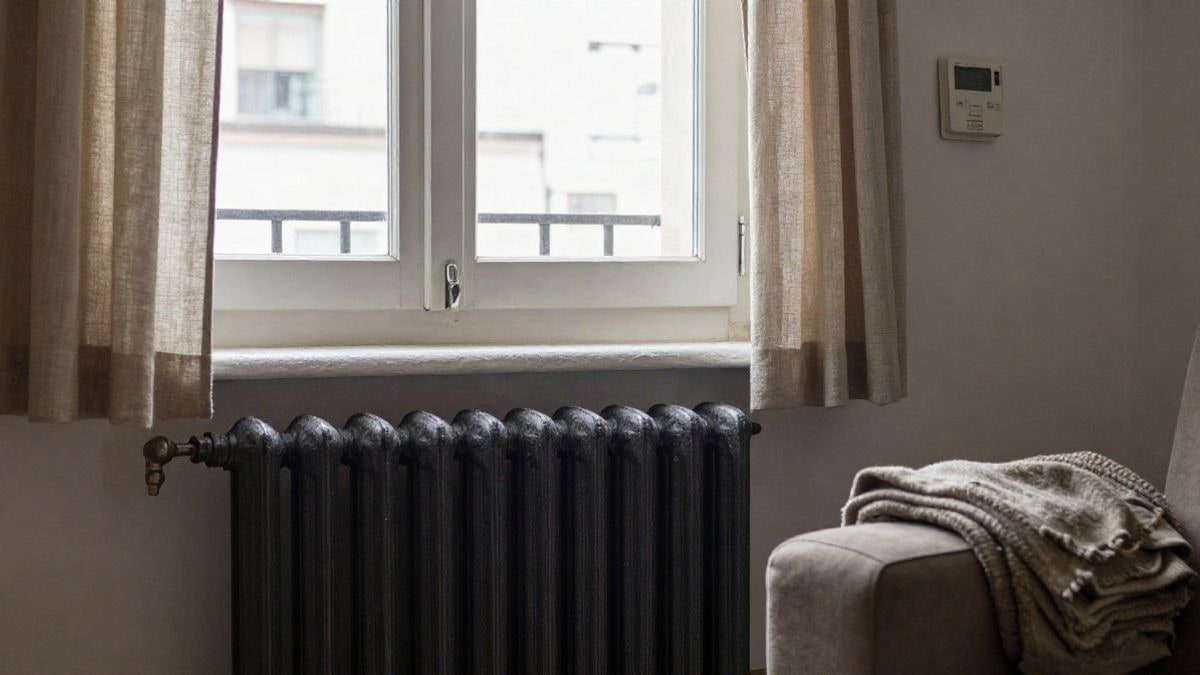
Radiators, almost always poorly placed
A radiator covered by a sofa or hidden behind a thick curtain heats the fabric and not the room. Ideally, leave about 3 centimetres between the radiator and the wall and avoid placing furniture directly in front of it. If the radiator is next to an exterior wall, a reflective panel placed behind it returns some of the heat back into the room. Its effect is modest, but it is noticeable on a cold wall.
If the radiator is cold at the top and hot at the bottom, or sounds gurgling, it has air inside. With a bleed key, a container, and a cloth, it can be released in a few minutes. Do this with the heating off and then check the boiler pressure, which should be between 1 and 1.5 bar on the gauge.
Thermostatic valves on each radiator allow you to regulate each room separately. The bedroom you hardly use doesn't have to be the same temperature as the living room. In many cases, installation is straightforward, although it's advisable to have an installer confirm if your system allows it.
Doors, windows, and drafts
This is where most heat escapes without us seeing it. A draft excluder on the front door, sealing the frames with silicone that whistle, and checking the window seals are cheap fixes that usually make a difference. On a windy day, run your hand along the gaps: if you feel air, then air is also coming in, and the heating works harder to compensate.
Thermal curtains, with lining or dense fabric, reduce heat loss through the glass, especially in windows facing north. Raising the blinds during the day to let in the sun and lowering them in the evening is a simple routine that makes a difference. At Casa y Deco, we are fans of this habit, and of heavy linen curtains that go with almost everything.
Ventilate yes, but wisely. Opening the windows wide for five to ten minutes renews the air without cooling the walls. Leaving them ajar all afternoon is not ventilating; it’s giving heat away to the street.
Program the heat instead of turning it on randomly
A programmable thermostat allows the house to be warm by the time you arrive, without the boiler running in the early hours for no one. Smart models add mobile control, but simple ones are sufficient if you stick to the schedules. One hour in advance is usually enough in a well-insulated home, and the rest of the day you can leave it in reduced mode.
Checking the boiler once a year is not a luxury. A dirty or poorly regulated boiler consumes more to provide the same heat. If yours is condensing, its performance depends greatly on having a clean circuit and a low return temperature, which is why wide radiators and underfloor heating work so well with this type of equipment.
When the problem is the house, not the thermostat
If your home is old, with uninsulated walls and single-pane windows, no trick will significantly lower the bill. This is where facade or roof insulation comes in, which is the most cost-effective improvement in the long run. The IDAE manages aid programs for the energy rehabilitation of buildings, although the calls change depending on the autonomous community and type of work, so it’s advisable to consult them before starting.
If your home has low income, also check the Thermal Social Bonus, a discount on the gas or electricity bill for vulnerable consumers that is updated each year. The requirements change, so it's worth looking at the official information before giving up on the right.
If you only do one thing this week, bleed the radiators and check the boiler gauge. It takes about ten minutes, costs nothing, and with the system free of air and the pressure well adjusted, the heat reaches where it needs to go.

You may also like