If you have typed washbasin unit: how to choose it into the search engine, you are probably in the middle of a renovation or about to change your home’s bathroom. At Casa y Deco, we love this moment because it is the piece you see every morning and the one that most influences how a bathroom feels. We confess that the first time we renovated ours, we bought a beautiful unit that didn’t fit through the bathroom door. So here’s the guide we would have liked to have back then, with measurements, installation types and materials.
Start by Measuring the Space
The most common mistake is to focus on the design first and then on the dimensions. Measure the available width, the actual depth to the opposite wall, and the height to the ceiling, but also the door swing and the area you need free to move. In small bathrooms, units between 60 and 80 cm are usually the most practical option, while those from 90 to 120 cm work well in medium-sized bathrooms with some storage. If your bathroom is very narrow, look for a depth of 35 to 40 cm, which frees up space without sacrificing drawers.
For family or shared bathrooms, units of 150 to 180 cm with double sinks prevent queues in the morning. However, before deciding, think about who uses it and at what time. A double sink is a wonderful luxury if there are two adults with similar schedules, and a hassle if only one person uses it.
Wall-Mounted, With Legs or With a Plinth
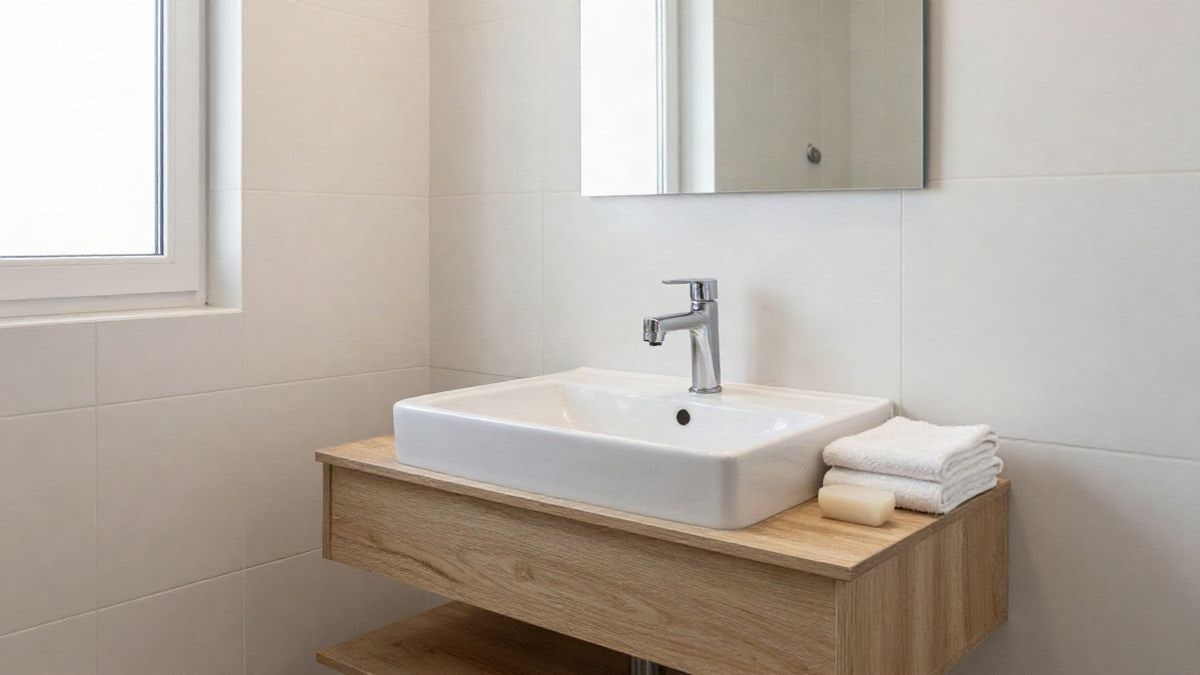
The installation greatly changes the feel of the space. Wall-mounted units are anchored to the wall and leave the floor free. Visually, they lighten the space, and cleaning underneath is much more convenient. Our advice is to check that the wall can support the weight, especially if it is made of lightweight partitioning, as it’s advisable to reinforce it with suitable anchors or even a support profile.
Legged models are more traditional and usually offer more storage capacity. They are installed without wall work, making them ideal if you don’t want to open grooves. Floor-standing units with a plinth rest on the ground with a closed base, which better protects against moisture and dust, although you lose that sense of lightness. We recommend them for heavily used bathrooms, where splashes are quite common.
Types of Washbasins: What Fits Each Unit
This is where we receive the most questions. The choice of washbasin must go hand in hand with the unit, as not all fit with everything. These are the most common types:
- Integrated Washbasin: built into the countertop. You need a precise cutout, so measure before buying.
- Countertop Washbasin: sits on top. It looks very stylish, but a high spout tap is advisable to have enough clearance for your hands.
- Undermount Washbasin: flush underneath, providing visual continuity to the surface. It’s easy to clean because there are no edges where dirt can accumulate.
- Integral Washbasin: the bowl and countertop are the same piece. It’s very practical and hygienic.
- Pedestal Washbasin: ideal for very small spaces, but be careful, the pedestal must be compatible with the washbasin you choose.
A detail that many overlook: tap, siphon and drain valve are almost never included. Check this before finalising your purchase, as an incompatible piece can delay the entire installation.
Materials: What Shows Over Time
The material determines both the aesthetics and the maintenance. A bathroom suffers from constant humidity, temperature changes, and cleaning products, so it’s wise to think long-term.
Painted MDF provides very uniform finishes at reasonable prices, but it needs a good protective lacquer if the bathroom has little ventilation. Melamine is the most economical option and can be cleaned with a damp cloth without complications, although don’t expect a luxury aesthetic. Solid wood brings unmatched warmth but requires varnish or oil and periodic checks. And metal with glass is very water-resistant and fits wonderfully in industrial styles, although the glass requires frequent cleaning to avoid water marks.
As for washbasins, ceramic is our favourite for everyday use. It is hard, resists knocks and scratches, and many current designs have eliminated joints, making cleaning much easier. Natural stone has a special charm and withstands temperature changes well, but it is somewhat delicate with stains, so always use neutral soap and avoid abrasive products. With resin, be wary of overly cheap offers: low-quality ones can delaminate and get dirty easily. It’s better to opt for well-known brands with a guarantee.
Style: It Shouldn’t Clash with the Rest
The bathroom unit must coexist with tiles, taps, mirrors, and towels, so it’s worth thinking about the whole ensemble. Modern styles often feature smooth surfaces, hidden handles, and colours like white, grey, or light wood. Rustic styles play with solid wood, iron, and stones. Classic styles are recognised by their mouldings and golden or silver details.
We have a confessable weakness for washbasins with vintage patterns. Some see them as overloaded, but a well-placed Toile de Jouy in a small bathroom can add enormous character. However, if you’re going to put a pattern on the washbasin, keep the rest of the elements neutral to avoid overwhelming the view.
Errors We’ve Made (So You Don’t Repeat Them)
Besides that unit that didn’t fit through the door, we made another mistake: we chose a drawer without considering the height of product bottles. We ended up storing shampoo on the floor of the unit. Before deciding, make a list of what you’re going to store, from the hairdryer to spare towels, and see if it fits. A deep drawer with dividers usually yields better results than a door with a shelf that no one can reach.
It’s also wise to check the height of the washbasin. A unit that is too low strains the back of taller individuals, and one that is too high can be uncomfortable for children. The usual measurement is around 80 to 90 cm in height for the countertop, although it’s ideal to try it in the actual space if you can.
Budget and Final Decision
Price isn’t everything, but it’s also not wise to skimp on what is most used. If the budget is tight, a melamine unit with a well-chosen ceramic washbasin can yield a decent and durable result. If you can invest more, treated wood or metal with glass adds a personality that is noticeable every day.
Before buying, review the list: exact measurements with margin, type of installation according to the wall, material suitable for humidity and ventilation, washbasin compatible with taps and drainage, and storage that meets your routine. If everything fits, it’s very likely that your bathroom will gain function and look good for years.

You may also like